

Improving Repair Flows in Customer Service

Coordinating Repair Across Customer-Service Channels

The Company’s brand is built on durability, but even the most resilient products eventually need care. In the US, the digital repair experience failed to reflect that promise. It lived on a separate domain, lacked account integration, and placed unnecessary pressure on customer service teams.

Without intervention, the organisation would likely have continued applying incremental fixes to the standalone repair site—improving instructions or contact options—without addressing the structural fragmentation or operational inefficiencies at the system level.

As UX lead, my objective was to design a repair journey that conveyed the same precision, reassurance, and care as the products themselves.


Challenge

Three issues defined the existing experience:

  • Fragmented flow due to separation from the main domain
  • Operational strain caused by ambiguous requests and manual handling
  • A missed brand moment during emotionally sensitive interactions

The most significant internal friction stemmed from the fragmented flow. Reintegration implied cross-departmental ownership, resource realignment, and changes to legacy operational processes.
Strategy

The UX strategy aligned emotional reassurance with operational clarity.


Human-Centred Content

User feedback consistently revealed uncertainty about what would happen after submitting a repair request. I designed a content system that clarified next steps, timelines, and expectations to rebuild trust and momentum.


Tiered User Access

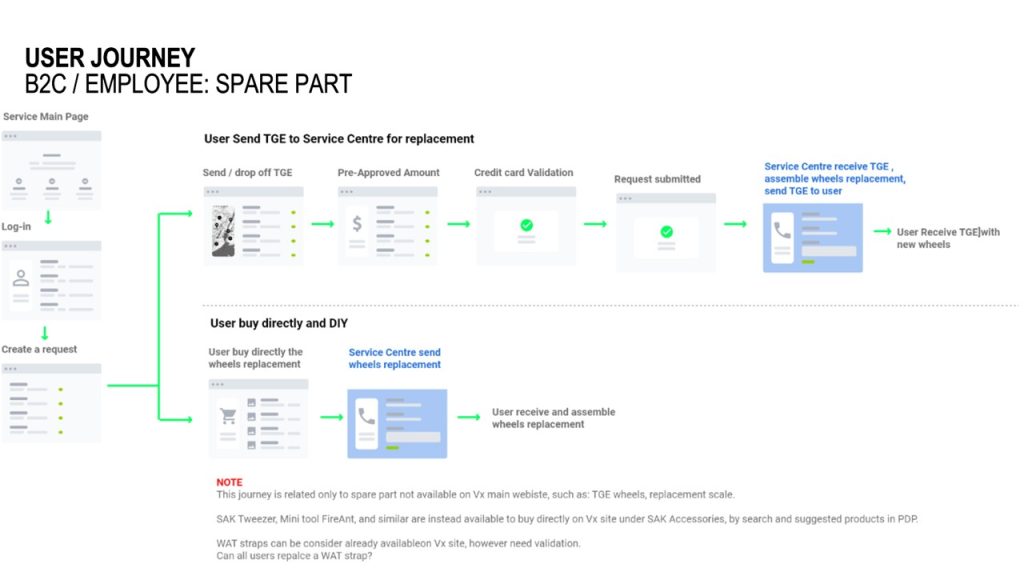
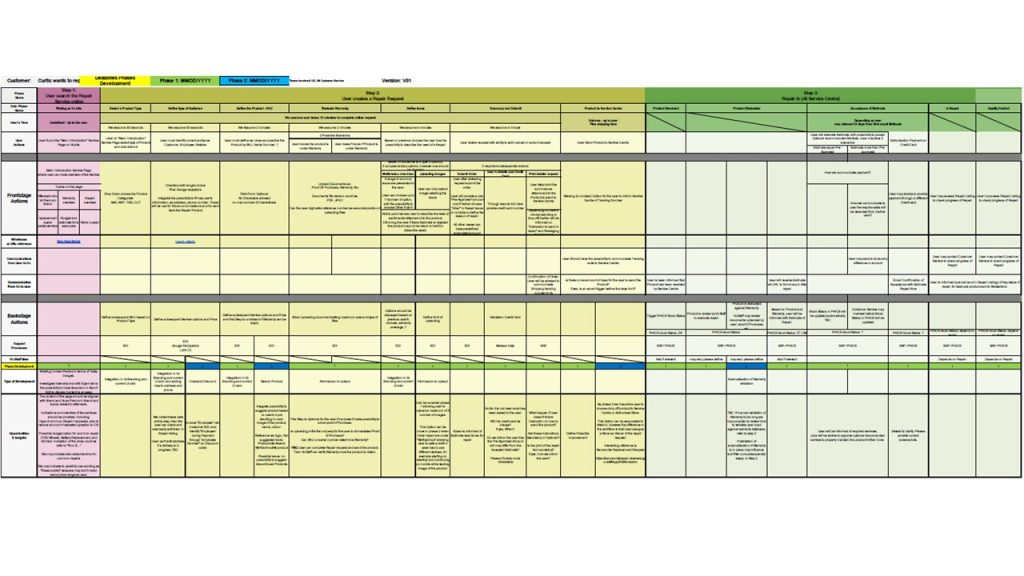
Journeys were differentiated for B2C customers, employees, and retailers, adapting language, inputs, and steps while maintaining visual consistency.
Seamless Service Integration
Where possible, the portal connected to existing user accounts while allowing guest access, mirroring eCommerce checkout patterns.


Modular, Step-Based Forms

The flow was structured into clear, adaptive steps. The early issue-description step proved most critical: once reframed with clearer examples and visual guidance, users felt confident continuing rather than abandoning the process.

Execution Highlights

Product & Issue

An early assumption proved incorrect: users did not describe repair issues using technical terminology. Most relied on everyday language, emotional descriptors, or incomplete statements. The form was redesigned to prompt and support this reality.


Shipping and Pre-Approval

Shipping options and estimated costs were surfaced early, with clear disclaimers and downstream connections to approval workflows.
Approval Logic
The greatest hesitation occurred when users were asked to approve an estimated cost without knowing whether alternatives existed. We addressed this by clarifying fallback options, including partial repairs, spare parts, or replacements.


Repair Dashboard

A logged-in dashboard allowed users to track repairs by status, date, and location. We monitored follow-up contacts, repeated status checks, and time spent on tracking views to assess whether reassurance needs were being met.

Outcome

The redesigned experience reframed after-sales service as a moment of reassurance rather than friction.

Customer service teams shifted from manual clarification and status updates to triage and exception handling, as users increasingly relied on self-service. Confidence improved, confusion decreased, and brand affinity strengthened during moments of vulnerability.

Reflection

A small content change had an outsized impact: adding clear, human-centred expectation statements at the start and end of the flow. Knowing what would happen next reduced uncertainty when trust was most fragile.

Repairs are not glamorous. They are emotional. UX in these moments is not about apology, but assurance, and about restoring confidence when it matters most.