


Portfolio
Talawa Theatre Company launched Talawa Make to address a long-standing structural gap in British theatre: the lack of sustained, professional support and visibility for Black British artists across career stages.
Talawa Make was conceived not as a single programme, but as a four-stage development ecosystem delivered through workshops, commissions, readings, and mentoring.
The challenge was to translate this ambition into a digital platform that could support connection, opportunity discovery, and professional credibility at scale, without reproducing the exclusionary dynamics common in creative networks.
As UX Designer, I led the design and implementation of the Talawa Make online community, shaping it as professional infrastructure, not a social network.
Project context
Challenge
The challenge was not technical delivery, but participation design.
Talawa needed a platform that enabled artists to be visible and discoverable without self-promotion fatigue, supported meaningful interaction without being dominated by a small minority of users, reflected professional theatre norms, and balanced openness with moderation, safeguarding, and governance.
Research and stakeholder discussions made one risk explicit: participation inequality would undermine the platform’s purpose.
The problem to solve was therefore clear: how do you design a professional community where contribution feels safe, lightweight, and worthwhile, especially for early-career artists?
Process and method
Strategy
The UX strategy focused on lowering the cost of participation while preserving professional standards.
Designing for Participation, Not Posting
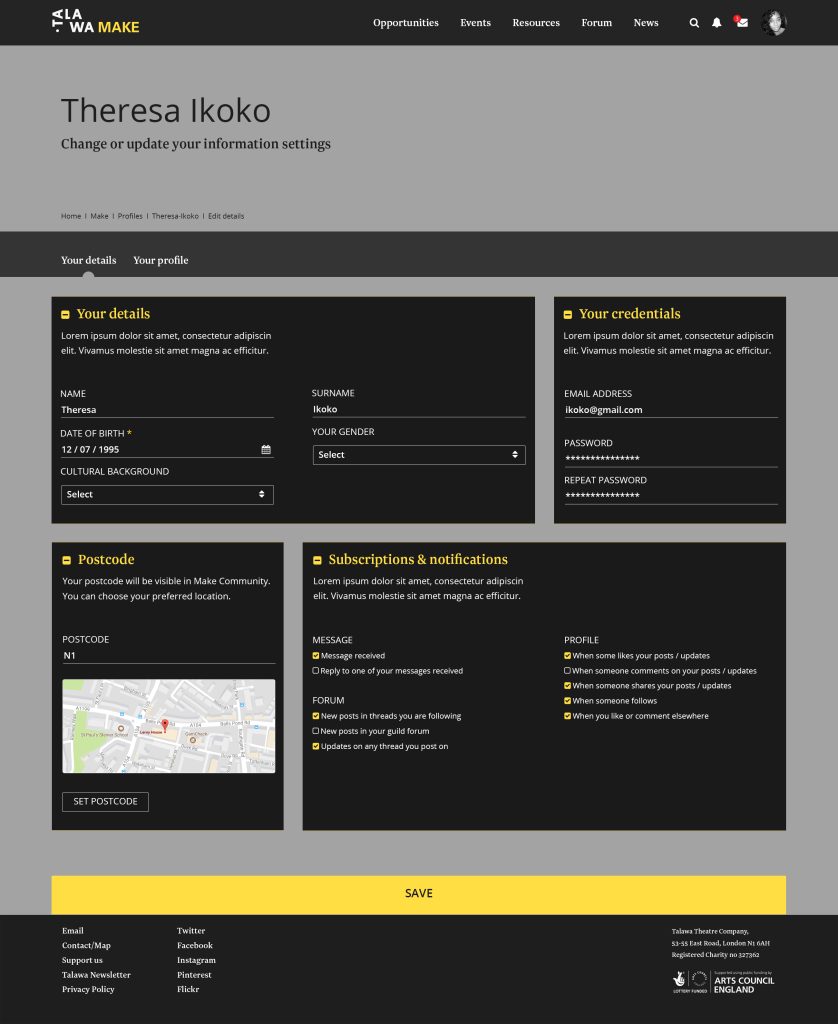
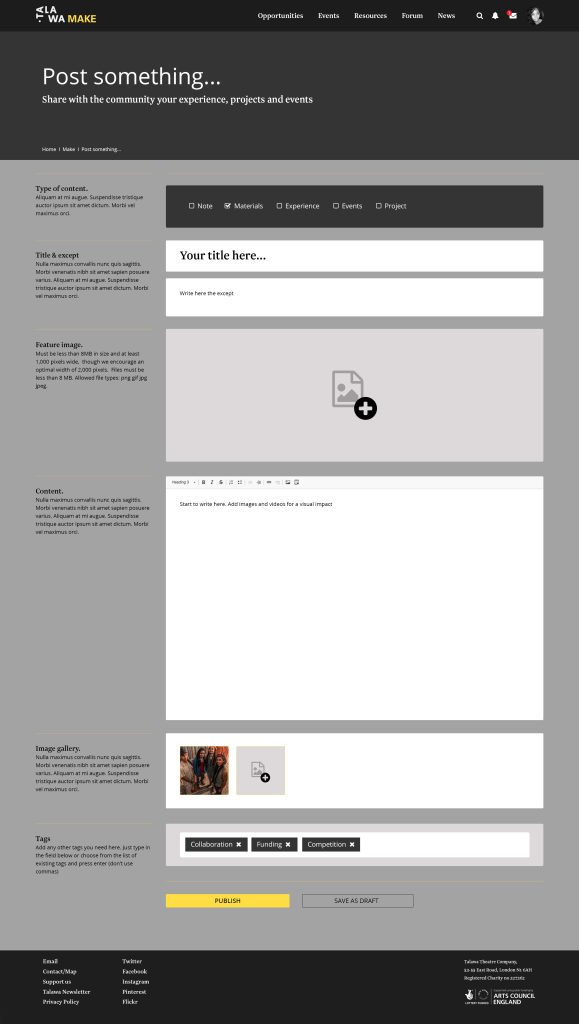
Rather than encouraging users to create content, the platform was designed so that participation emerged as a side effect of other actions such as applying, attending, bookmarking, editing, tagging, or responding.
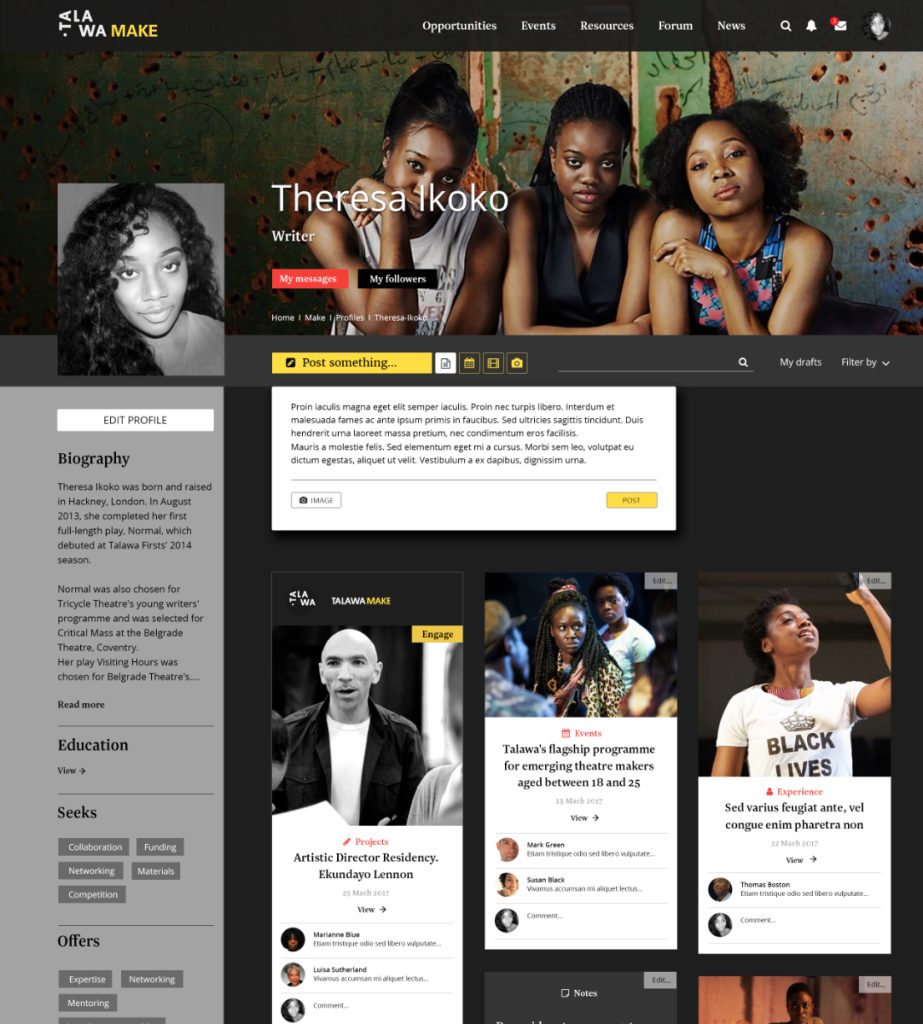
Profiles, events, and opportunities did most of the expressive work. This approach was directly informed by research on online community dynamics and aimed to prevent early drop-off or silent disengagement.
Audience-Aware Access and Permissions
Registration defined three distinct user types:
- Artists
- Industry
- Casual visitors
This distinction ensured that artists retained control over visibility and contact, industry participation supported opportunity flow without dominance, and unregistered users could explore value before committing.
Taxonomy Before Interface
A significant portion of the work focused on taxonomy and data structure, not screens.
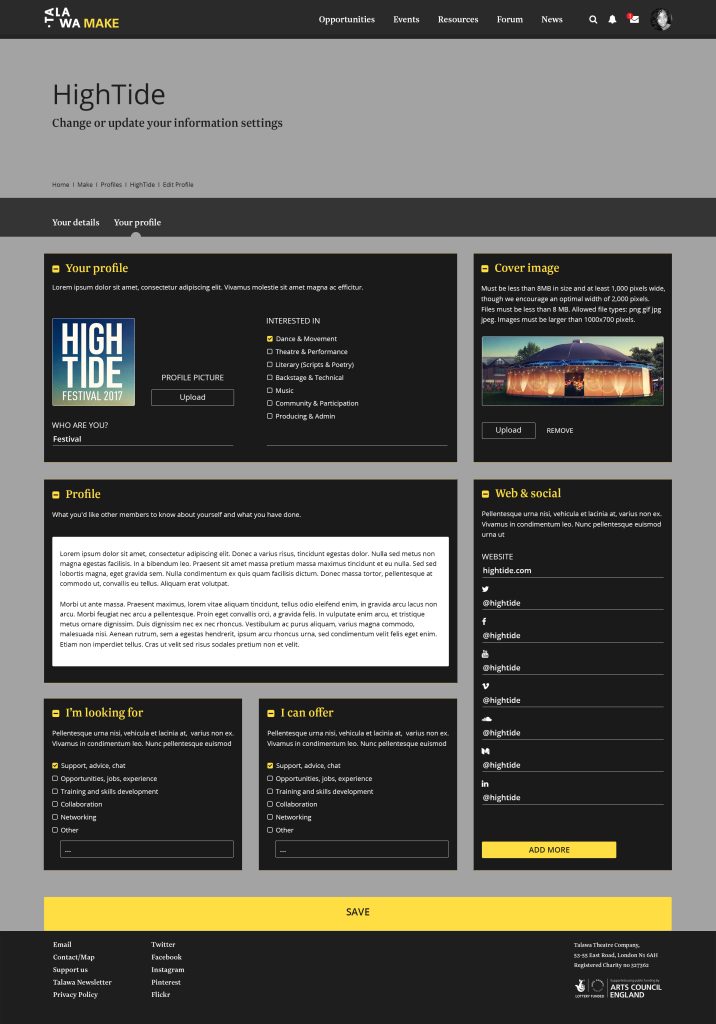
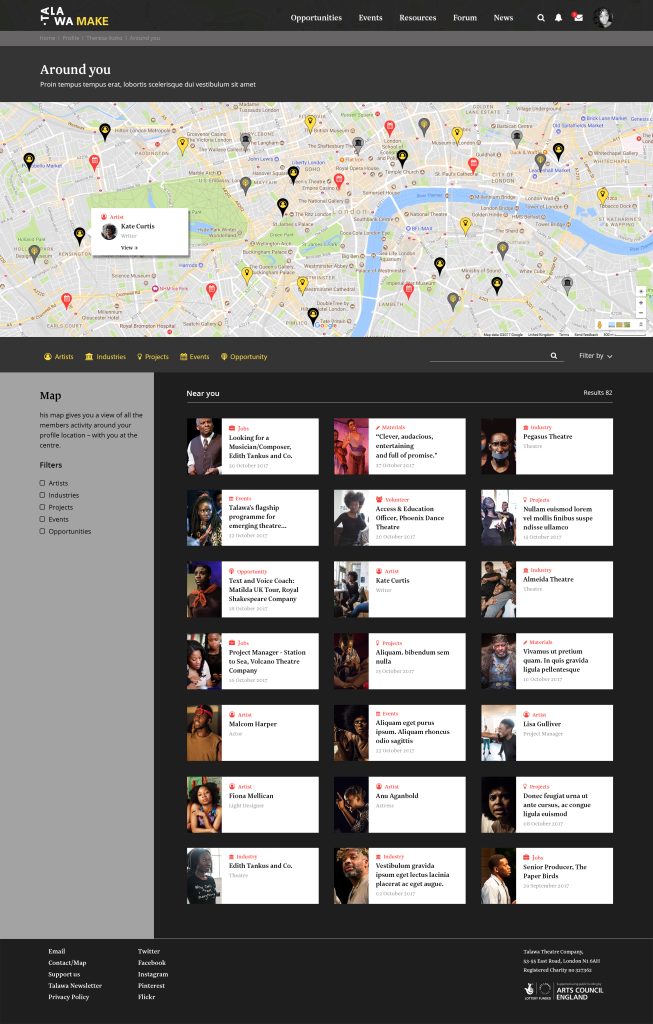
Skills, disciplines, interests, career stages, and motivations were defined early, enabling meaningful filtering and discovery, region-aware mapping, and personalised surfacing of opportunities and events.
Case study section
Prototyping and Validation
Prototyping was used deliberately at three stages.
Exploratory Prototypes
Static visual prototypes tested layout, hierarchy, tone, and brand application. These helped align stakeholders on what professional but welcoming looked like before development began.
Evaluative Prototypes
Key journeys including registration, profile creation, messaging, and content posting were tested on the development environment with representative users across artists, industry contacts, and platform administrators.
This surfaced friction around account setup, messaging expectations, and content visibility.
Beta Validation
A controlled beta with approximately 100 users allowed real-world observation of contribution patterns, navigation behaviour, moderation load, and profile completeness.
This phase was essential for refining interaction rules and reducing unintended friction before wider rollout.
Case study section
Implementation
The platform was built on Drupal, selected for its flexibility in permissions, content types, and moderation workflows.
To support parallel development, I recommended a structured deployment pipeline using Jenkins and GitHub, allowing:
- Features to be tested in isolation
- UX sign-off before release
- Reduced regression during iteration
This was particularly important given offshore development teams and a phased launch plan.

Result and impact
Outcome
Talawa Make Online launched as a professional infrastructure, not a social experiment.
The platform:
- Enabled artists to present themselves credibly and consistently
- Supported discovery of opportunities, events, and peers across regions
- Reduced reliance on informal networks and insider knowledge
- Gave Talawa visibility into engagement patterns without compromising trust
By prioritising structure, permissions, and taxonomy, the platform avoided common failure modes of creative communities: noise, inequality, and disengagement.
Reflection
Reflection
This project reinforced a core UX lesson: community platforms do not fail because of missing features. They fail because participation feels risky, performative, or unrewarded.
Designing Talawa Make required treating UX not as interface optimisation, but as social infrastructure design, where clarity, boundaries, and governance matter as much as interaction.
The success of the platform lay not in how much content users created, but in how confidently they chose to participate.