
The Company approached its holiday campaigns with a clear ambition: convert seasonal traffic into meaningful engagement and confident purchasing decisions.
Earlier campaigns assumed that high holiday intent meant users already understood the product value and needed only visual appeal and refreshed layouts to convert. In reality, users required reassurance, guidance, and clearer differentiation, especially under time pressure.
I led UX research and usability testing across successive holiday campaigns, guiding their evolution from surface-level optimisation toward behaviourally informed experiences.
The initial goal was direct: understand why a visually refined landing page failed to convert during high-stakes holiday moments.
Usability testing revealed that users were not lost; they were unconvinced. Under time pressure and emotional load, behaviour changed markedly. Users became more risk-averse, scanned less, and relied on quick heuristics.
These hesitation points reappeared across successive holiday seasons, particularly around uncertainty about product suitability, shipping timing, and gift appropriateness.
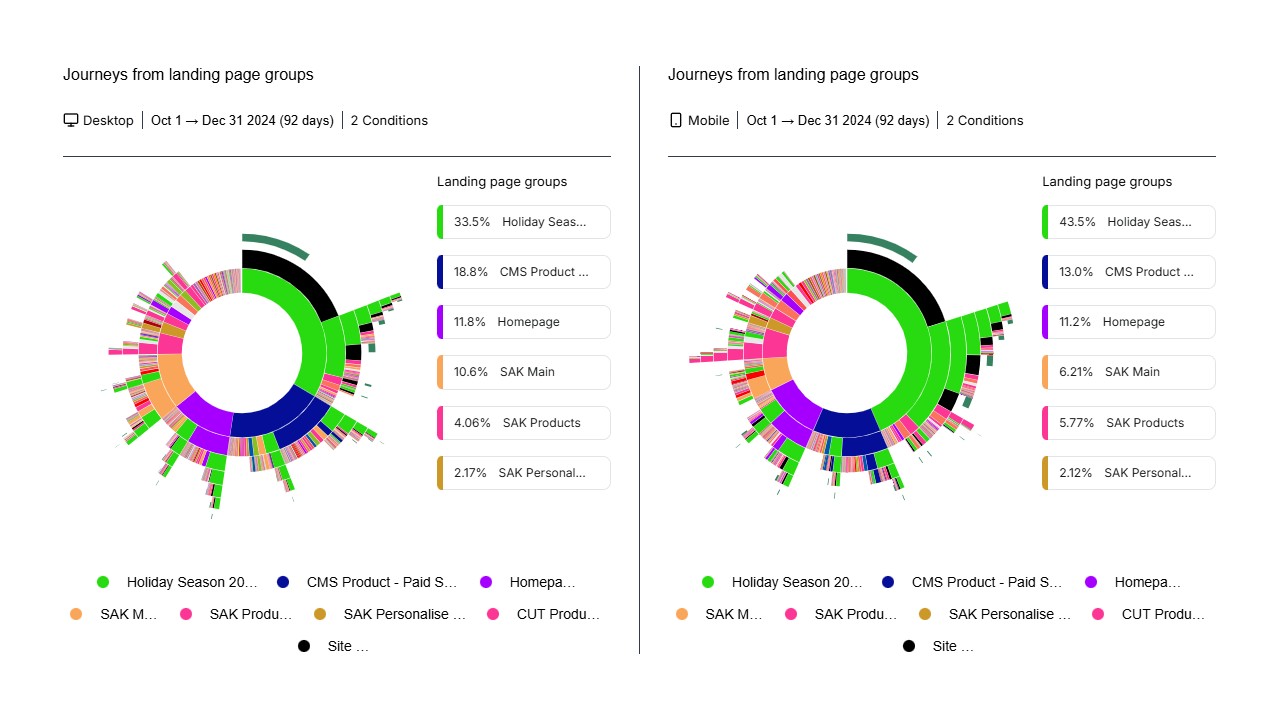
Quantitative data confirmed limited engagement beyond the first scroll. Qualitative sessions explained why: unmet expectations and delayed reassurance.
Primary Methods
– Remote usability testing, including five-second tests
– Targeted user interviews
– Scroll-depth and click data analysis
– Prototype evaluation of new layout variations
Diagnosing Misalignment Through Usability Testing
The same pattern emerged repeatedly: users were not confused enough to stop, but not confident enough to convert.
One participant captured the tension clearly: after filtering, they felt mostly confident they had found the right product, but still worried there might be a better option they had missed.
With baseline issues identified, the focus shifted from diagnosis to intentional redesign.
One design direction was deliberately deprioritised: a visually dominant, hero-first layout that pushed explanatory content further down the page. Testing showed that users needed clearer value framing and decision aids earlier, not more visual emphasis.
Using behavioural principles, the journey was reshaped to reduce cognitive load, strengthen salience, and align content order with how decisions are made under pressure.
The landing page evolved from a static presentation into a sequence of deliberate decision moments, separating inspiration from commerce, elevating the Gift Finder, clarifying support pathways, and rewriting copy for rapid scanning.
Primary Methods
– Scenario-based usability testing
– GA4 behavioural data review
– ContentSquare heatmaps
– A/B test planning
– Device-specific observations
– Feedback analysis from live prototypes
Real-Time Research During Campaign Rollout
Before launch, we conducted pre-live validation to refine nuance rather than uncover major flaws.
At one point, analytics suggested improved click-through on promotional elements. However, usability sessions revealed that many of these clicks were driven by uncertainty rather than true engagement.
The tension was resolved by restructuring the hierarchy so promotional elements supported, rather than replaced, decision-critical content.
A small change produced a disproportionate effect: introducing concise, high-salience value statements such as warranty, gifting suitability, and delivery certainty directly above the product grid. This reduced early-journey hesitation and restored confidence.
This project was not about redesigning a landing page. It was about learning how people decide when attention is fragmented and stakes are high.
Clarity, in these moments, is not aesthetic. It is functional.
Research embedded into planning, prioritisation, and platform strategy across a growing digital ecosystem.
A reusable model for comparing UX impact across initiatives without inflating results.