The Material of Teaching · Cross-functional working session
In this article
- The decision: when AI joins a customer service conversation, design for whoever reads it next, not only for the people in it.
- The method: map each conversation on seven swimlanes, so you can see where AI sits and who reads the record later.
- The scenarios: twenty patterns in four groups, each with a blueprint and one question to ask.
- Who does what: customer service, store operations, digital product, data protection and accessibility each own part of the chain, and someone has to own all of it.
- The instrument: a blank blueprint template for a working session.
A model to adapt, not a fixed list. The scenarios describe patterns that are already common in retail service. Start from your own tickets, calls and chats, and use these to recognise what you find.
The decision this article is about: when AI joins a customer service conversation, design for the person or system that reads it next, not only for the people in it.
The situation
At a shop counter, the person you spoke to was your audience. That is no longer true. A chat becomes a log, a headset exchange becomes a transcript, a call becomes a summary, and a returns page becomes the source for a public AI tool. Each of these has a second audience: a manager, the next shift, an analytics system, another AI.
People change what they say depending on who they think is listening. When the second audience is invisible, they can’t, and neither can the service.
The field note Who’s listening? The two audiences of AI conversations sets out the argument and its sources. This article turns it into material for a working session.
The trap
Teams map the visible exchange, the chat window or the call script, and stop at the line of interaction. The reader that matters most usually sits below the line of visibility, or outside the company altogether.
How to read the blueprints
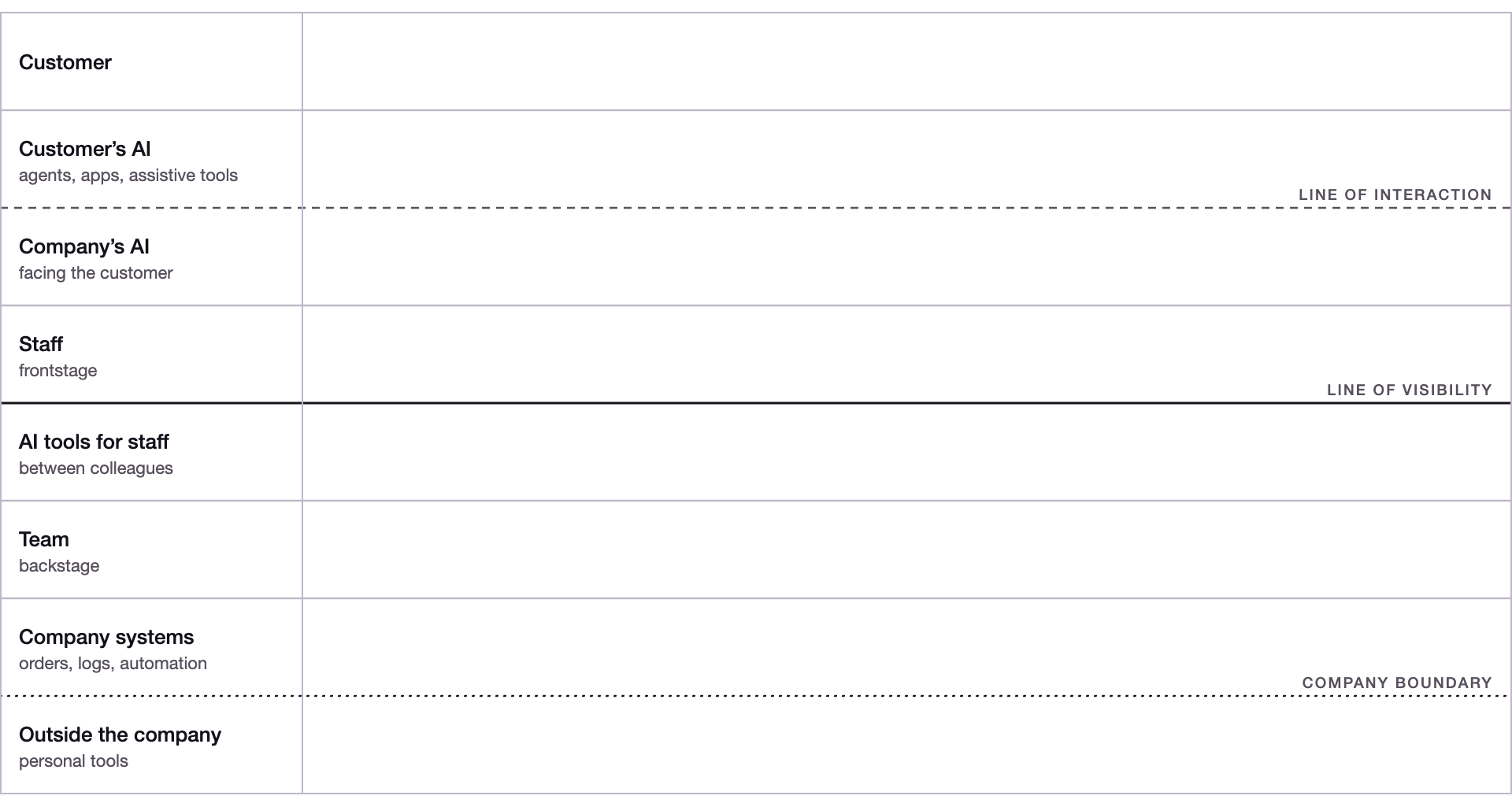
Each scenario is drawn on the same seven lanes. The order matters: every AI lane sits between the people it connects.
| Lane | What it holds |
|---|---|
| Customer | The person being served. |
| Customer’s AI | Agents, apps and assistive tools working for the customer. |
| Company’s AI, facing the customer | The chatbot, voice bot or agent that stands between the customer and staff. |
| Staff | Colleagues the customer deals with, in store, on the phone or by email. |
| AI tools for staff | Transcription, summaries and suggested answers that sit between colleagues. The customer never sees them. |
| Team | Managers and colleagues backstage. |
| Company systems | Orders, logs and automated decisions. |
Two scenarios add an eighth lane, outside the company: a staff member’s personal AI tool, and a recording seen by people beyond the shop.
A filled dot is a person and a hollow dot is an AI. Numbers show the order of steps. A dashed ring marks the hidden party: whoever reads, writes or listens unseen. The dashed line is the line of interaction; the solid line is the line of visibility.
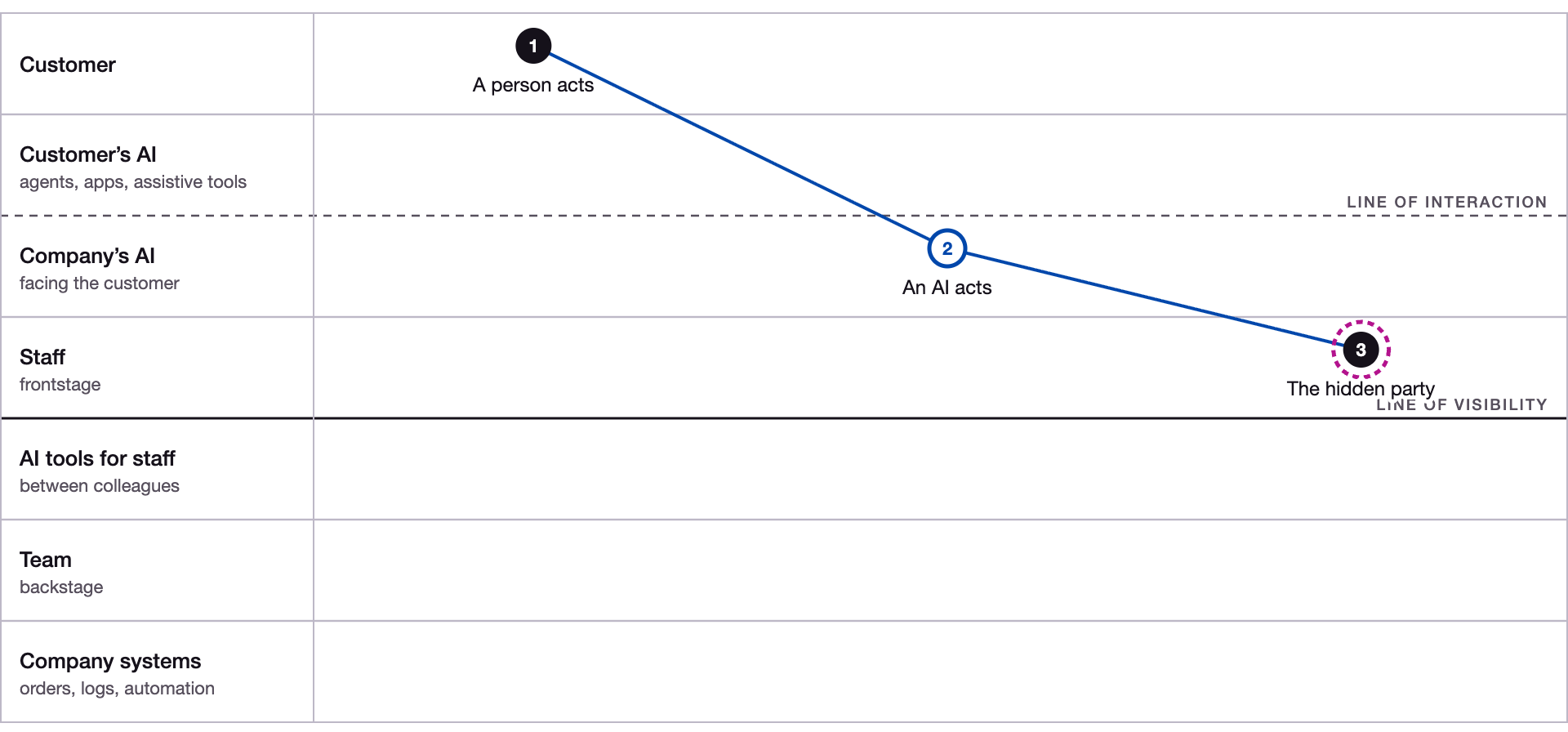
The model starts from Sarah Gibbons’ Every AI System Is a Service (Gibbons & Moran, November 2026), which gives each side of the service a row for people and a row for agents. Here the lanes are reordered so each AI sits between the parties it connects, and the company’s AI is split in two: AI that faces the customer, and AI that colleagues use with each other.
Customer to company
The customer, or the customer’s own AI, speaks to the company.
The site assistant
Customer > Company’s AI
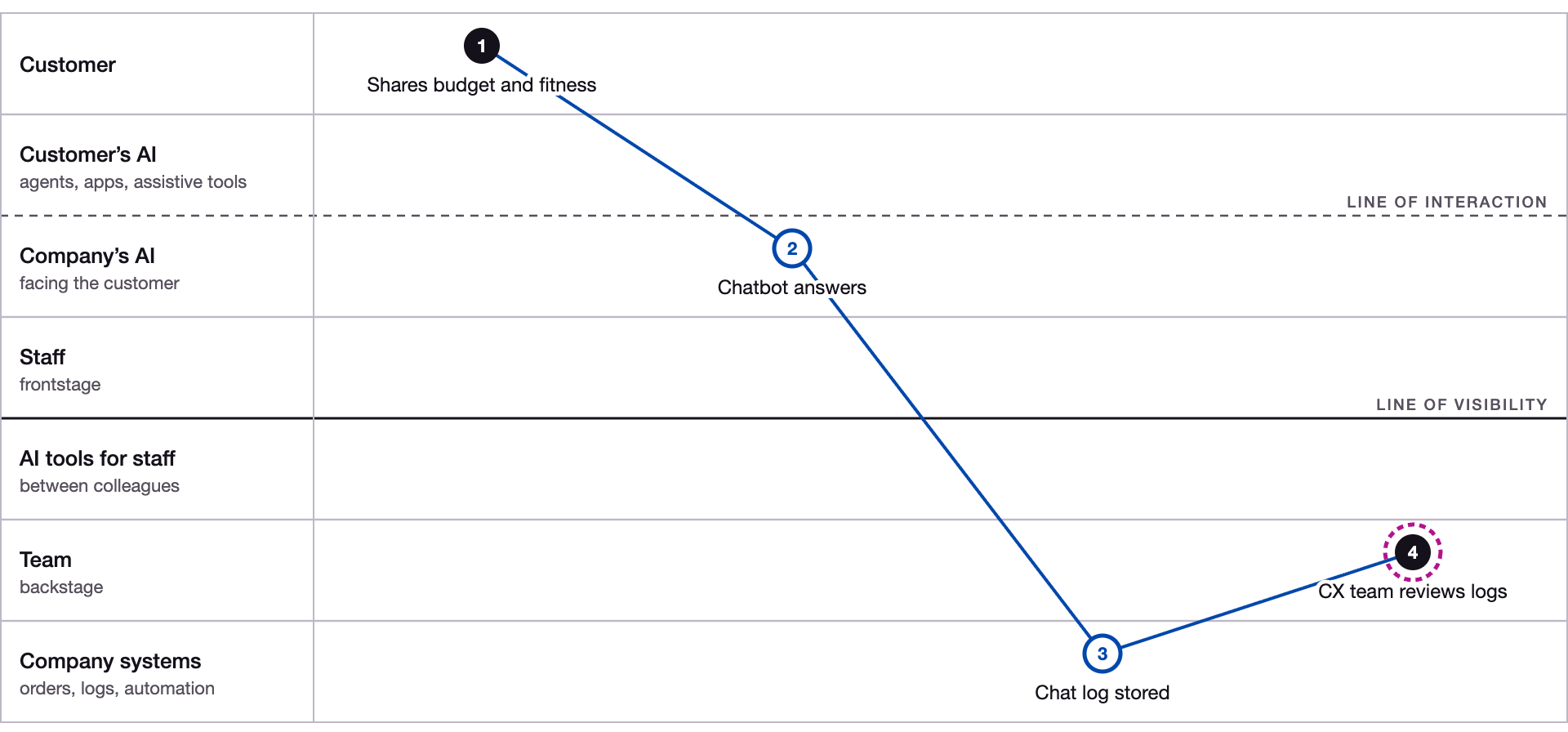
Customers tell a chatbot things they would not tell a person: the real budget, the real fitness level. They hold back once they think it keeps a record.
Steps as text
- Shares budget and fitness (Customer)
- Chatbot answers (Company’s AI)
- Chat log stored (Company systems)
- CX team reviews logs (Team)
Hidden party: The CX team reviewing chat logs
Ask: Does the customer know the chat is kept, and who reads it?
The AI shopping agent
Customer’s AI > Company’s AI > Staff
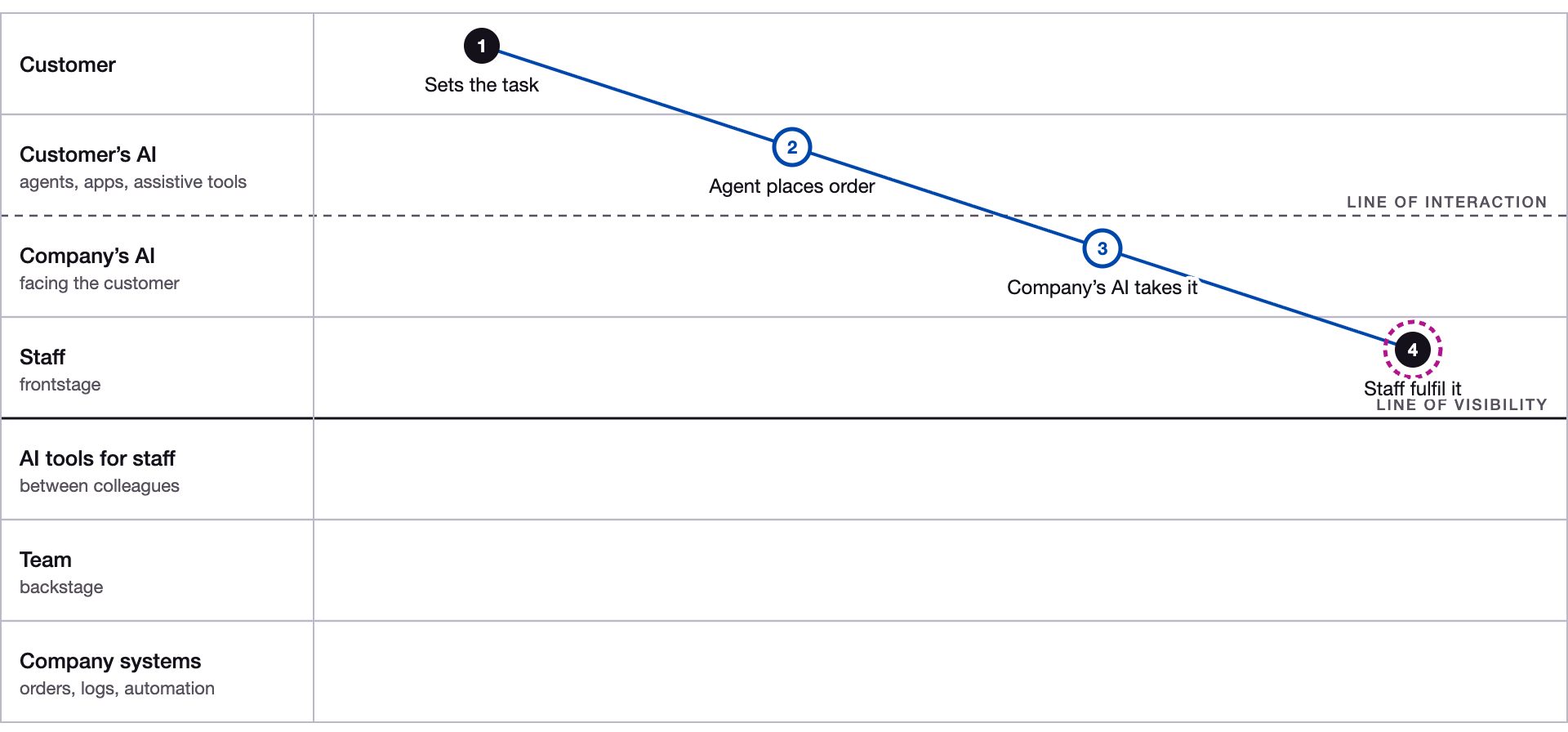
The order passes through two AIs before a person sees it. Nobody can be sure what the customer actually asked for.
Steps as text
- Sets the task (Customer)
- Agent places order (Customer’s AI)
- Company’s AI takes it (Company’s AI)
- Staff fulfil it (Staff)
Hidden party: Staff acting on an order no person wrote
Ask: Can staff see what the customer actually authorised?
The customer’s AI on the phone
Customer’s AI > Staff, by phone
A pleasant voice asks whether the waterproof version is in stock. Staff answer without knowing they are talking to a machine.
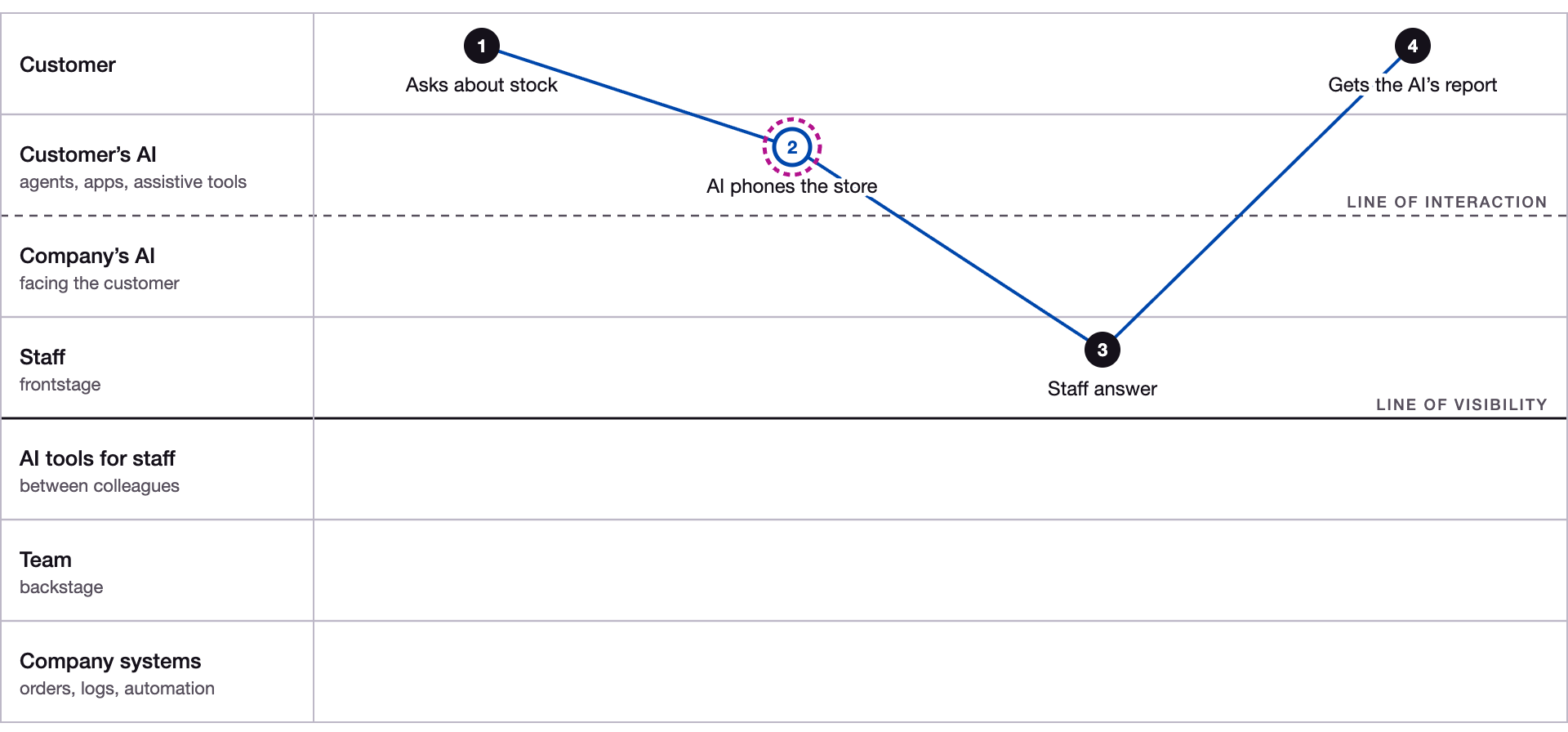
Steps as text
- Asks about stock (Customer)
- AI phones the store (Customer’s AI)
- Staff answer (Staff)
- Gets the AI’s report (Customer)
Hidden party: The customer’s AI, listening to staff
Ask: How would staff know they are talking to a machine?
The complaint
Customer with AI > Staff, by phone
The customer used AI to back the complaint with references they don’t know themselves. Staff call to hear what the customer actually means.
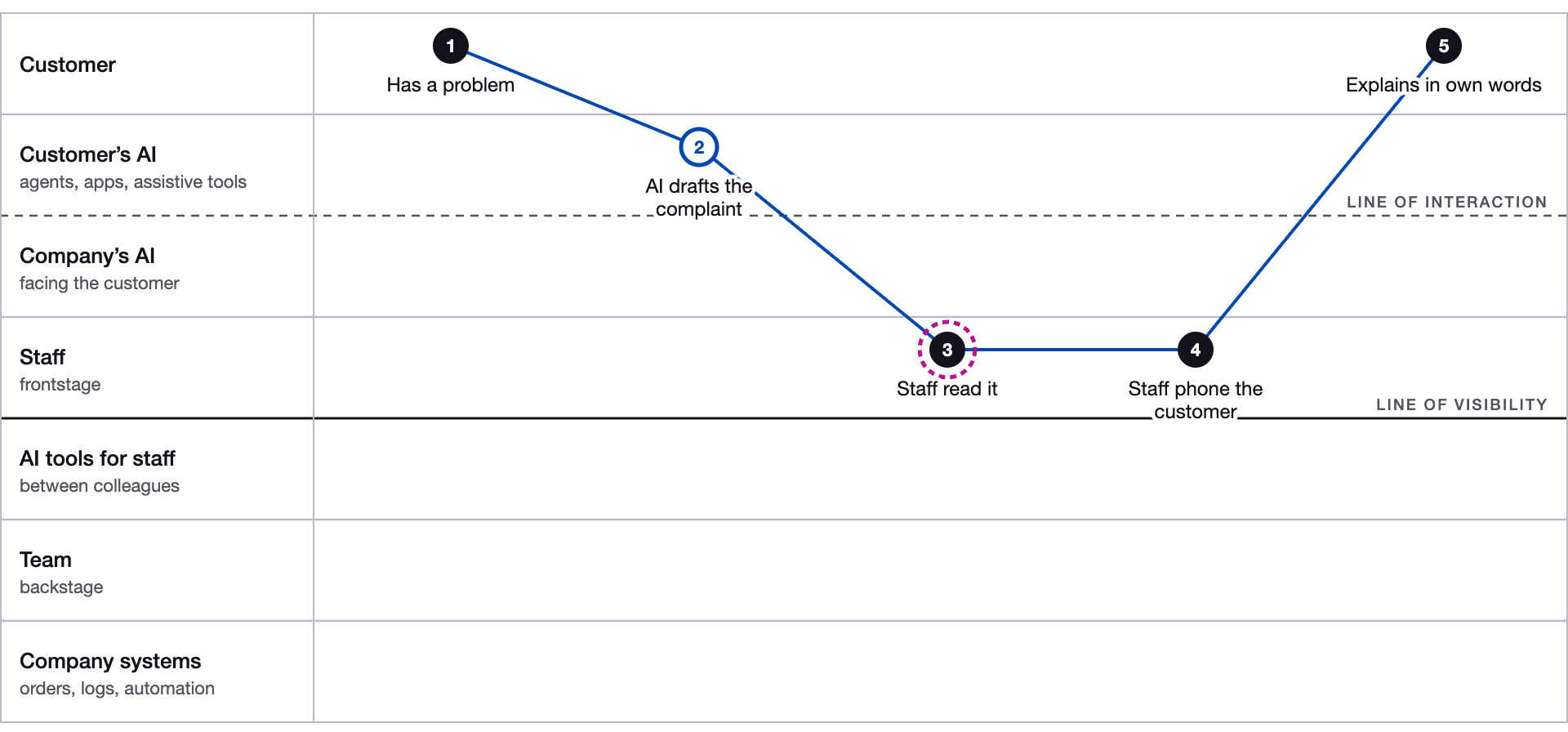
Steps as text
- Has a problem (Customer)
- AI drafts the complaint (Customer’s AI)
- Staff read it (Staff)
- Staff phone the customer (Staff)
- Explains in own words (Customer)
Hidden party: Staff, reading words the customer didn’t write
Ask: Which parts of the complaint does the customer stand behind?
The photo
Customer’s photo > Company’s AI check > Staff
The refund photo is checked for signs of AI. Honest customers are asked for more proof: another photo, a video, a trip back to the shop.
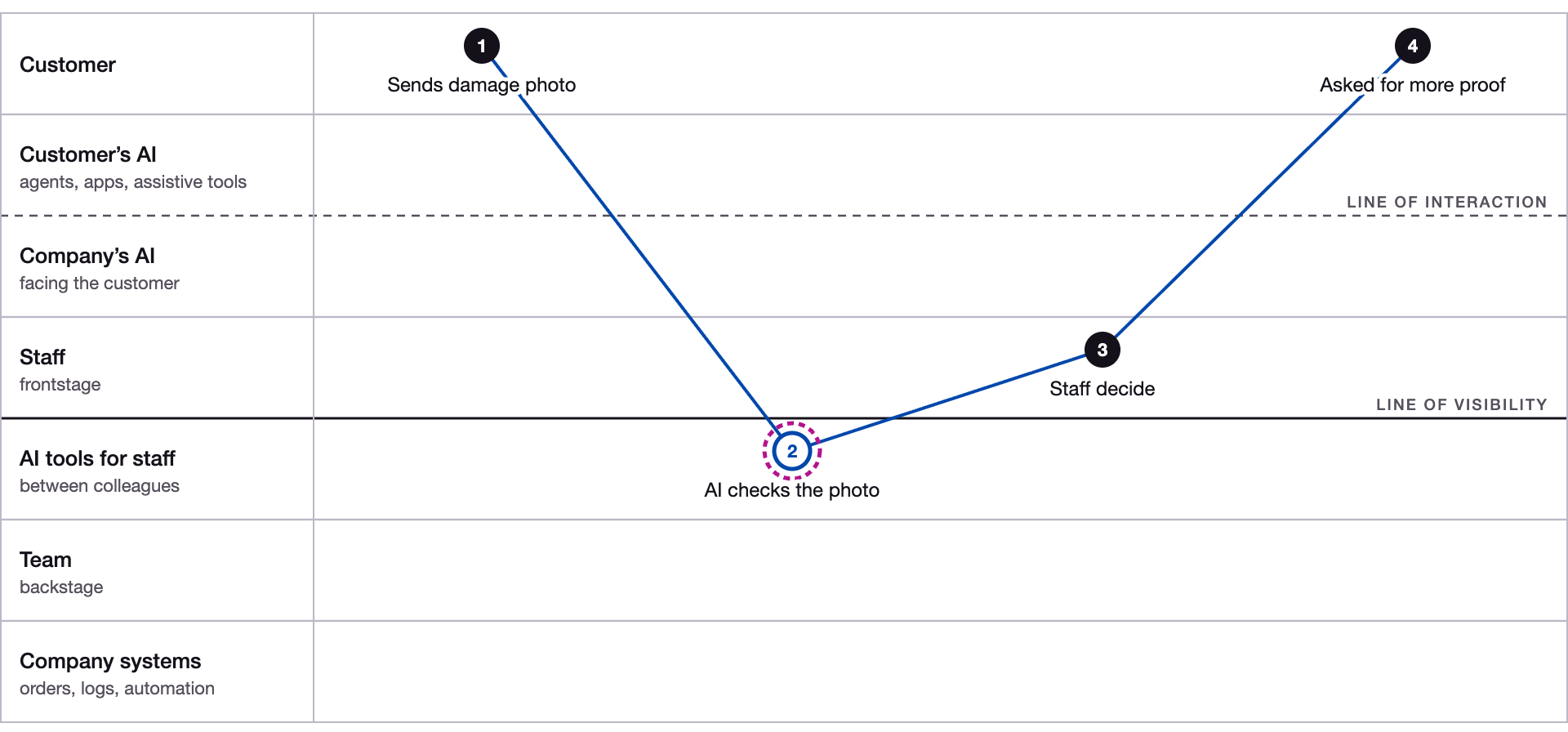
Steps as text
- Sends damage photo (Customer)
- AI checks the photo (AI tools for staff)
- Staff decide (Staff)
- Asked for more proof (Customer)
Hidden party: The company’s AI checking the photo
Ask: What happens to honest customers when the check is unsure?
The review
Customer’s AI > Company’s AI summary > Shopper
A review written with AI about a real experience is probably not a fake review under UK law. The next shopper reads an AI summary of it, and can’t tell whose words they are.
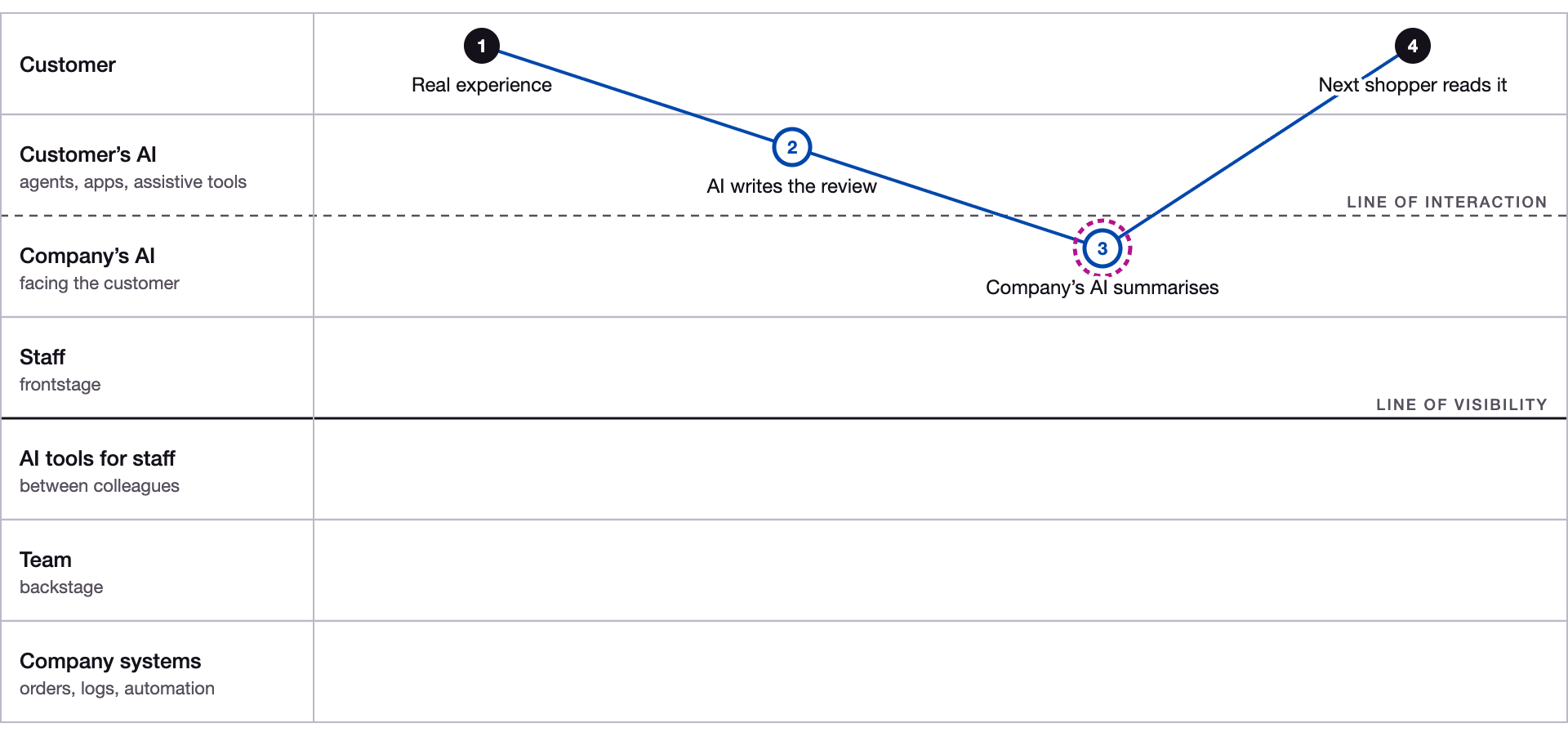
Steps as text
- Real experience (Customer)
- AI writes the review (Customer’s AI)
- Company’s AI summarises (Company’s AI)
- Next shopper reads it (Customer)
Hidden party: The company’s AI summarising the review
Ask: Whose words does the next shopper actually read?
Company, about the customer
Staff and systems talk about the customer, who is not in the conversation.
The transcript
Staff on headset > AI transcript > Manager
Two colleagues discuss the customer over a headset. AI turns it into text for a manager. The customer never knows.
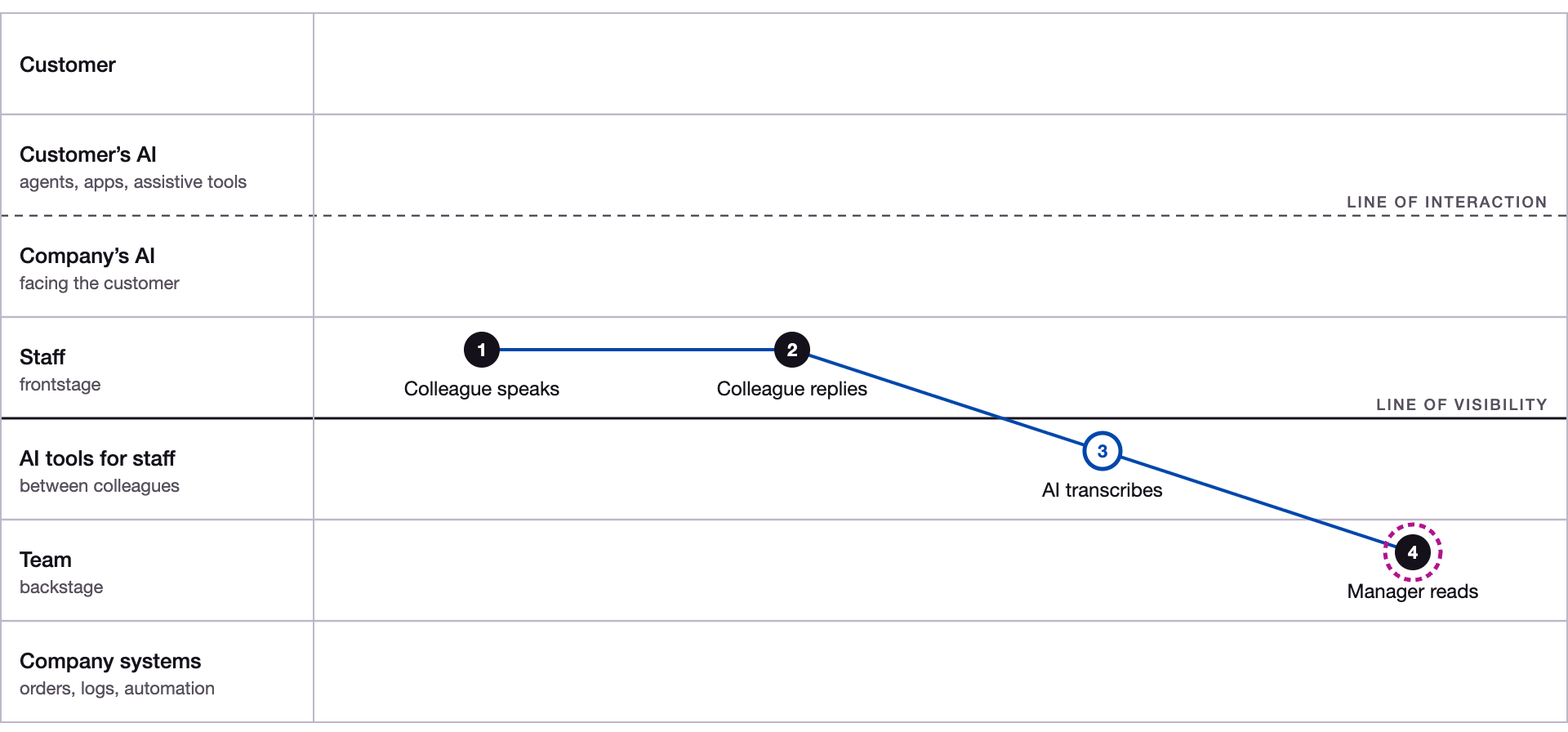
Steps as text
- Colleague speaks (Staff)
- Colleague replies (Staff)
- AI transcribes (AI tools for staff)
- Manager reads (Team)
Hidden party: The manager reading the transcript
Ask: Do staff know their headset talk becomes text, and who reads it?
The handover note
Staff > AI summary > Next shift
The next colleague reads a summary, not the conversation. What it left out is lost, and nothing shows it was there.
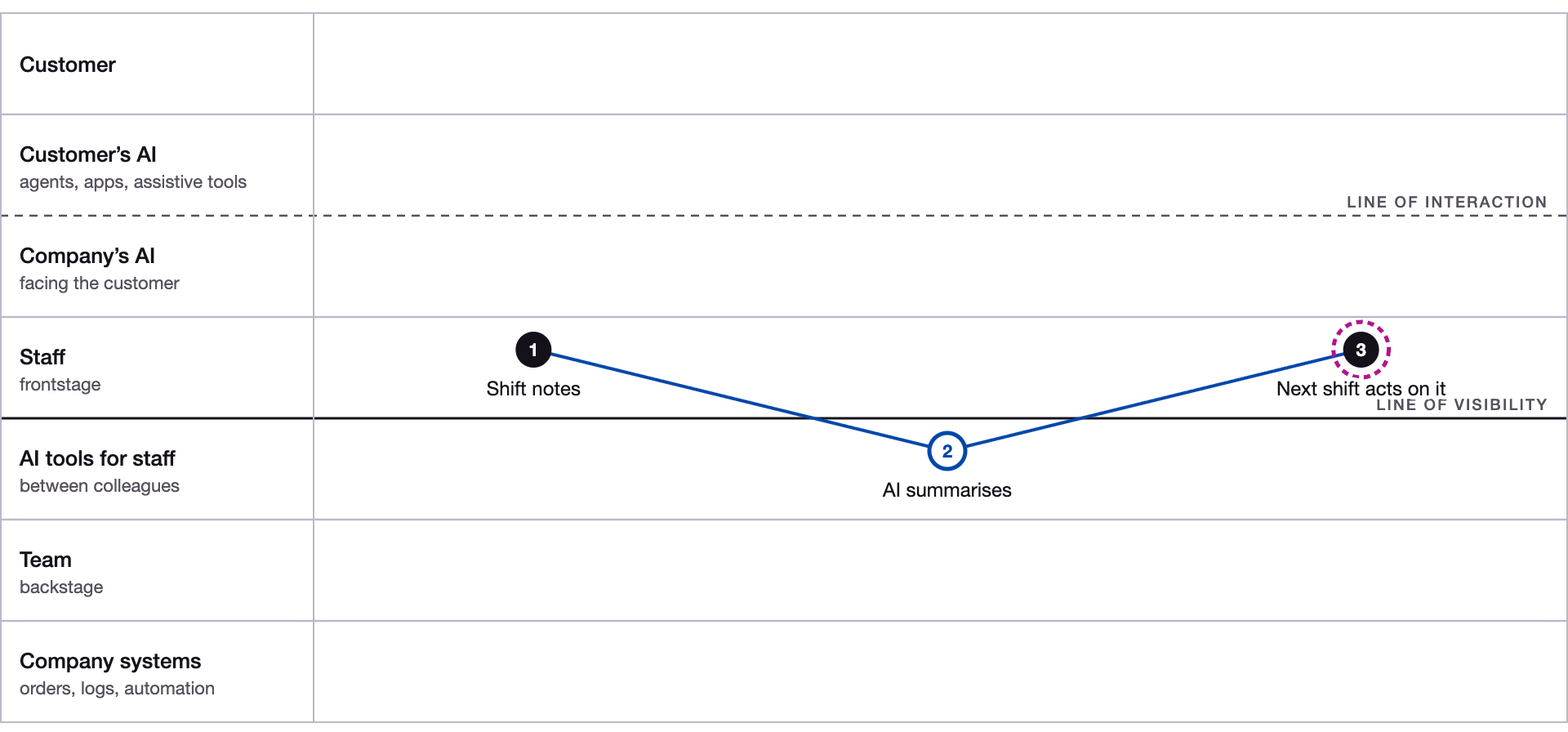
Steps as text
- Shift notes (Staff)
- AI summarises (AI tools for staff)
- Next shift acts on it (Staff)
Hidden party: The next shift, reading only the summary
Ask: What did the summary leave out, and how would anyone know?
The chatbot handoff
Customer > Company’s AI > Staff
Staff pick up from the bot’s summary. If it’s thin, the customer repeats everything.
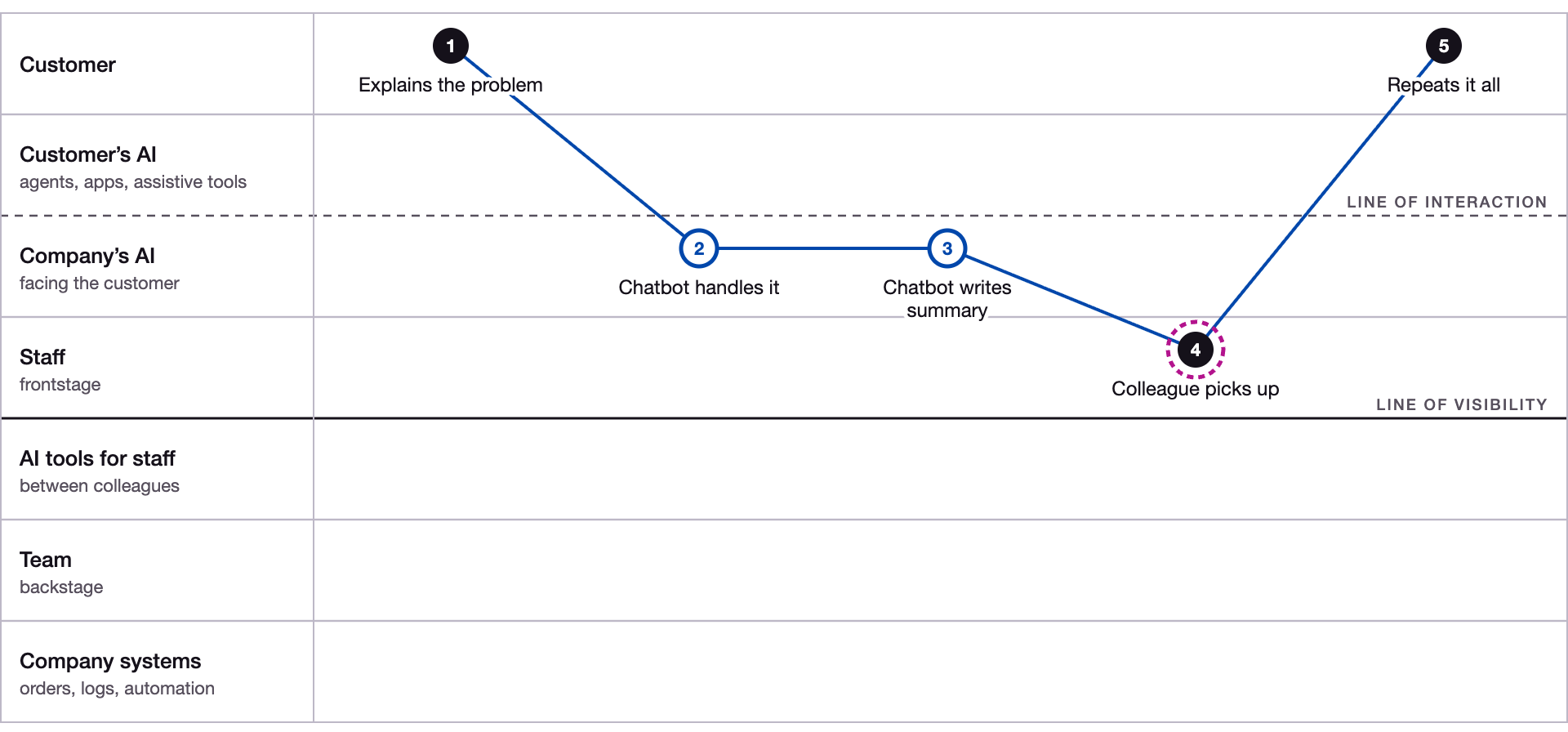
Steps as text
- Explains the problem (Customer)
- Chatbot handles it (Company’s AI)
- Chatbot writes summary (Company’s AI)
- Colleague picks up (Staff)
- Repeats it all (Customer)
Hidden party: The colleague, reading only the bot’s summary
Ask: Does the colleague get the conversation, or only the bot’s summary?
Company to customer
Staff, or the company’s AI, speak to the customer.
The prompted answer
Staff with AI > Customer
The associate reads out the AI’s suggestion. The customer trusts the person; if the answer is wrong, the associate takes the blame.
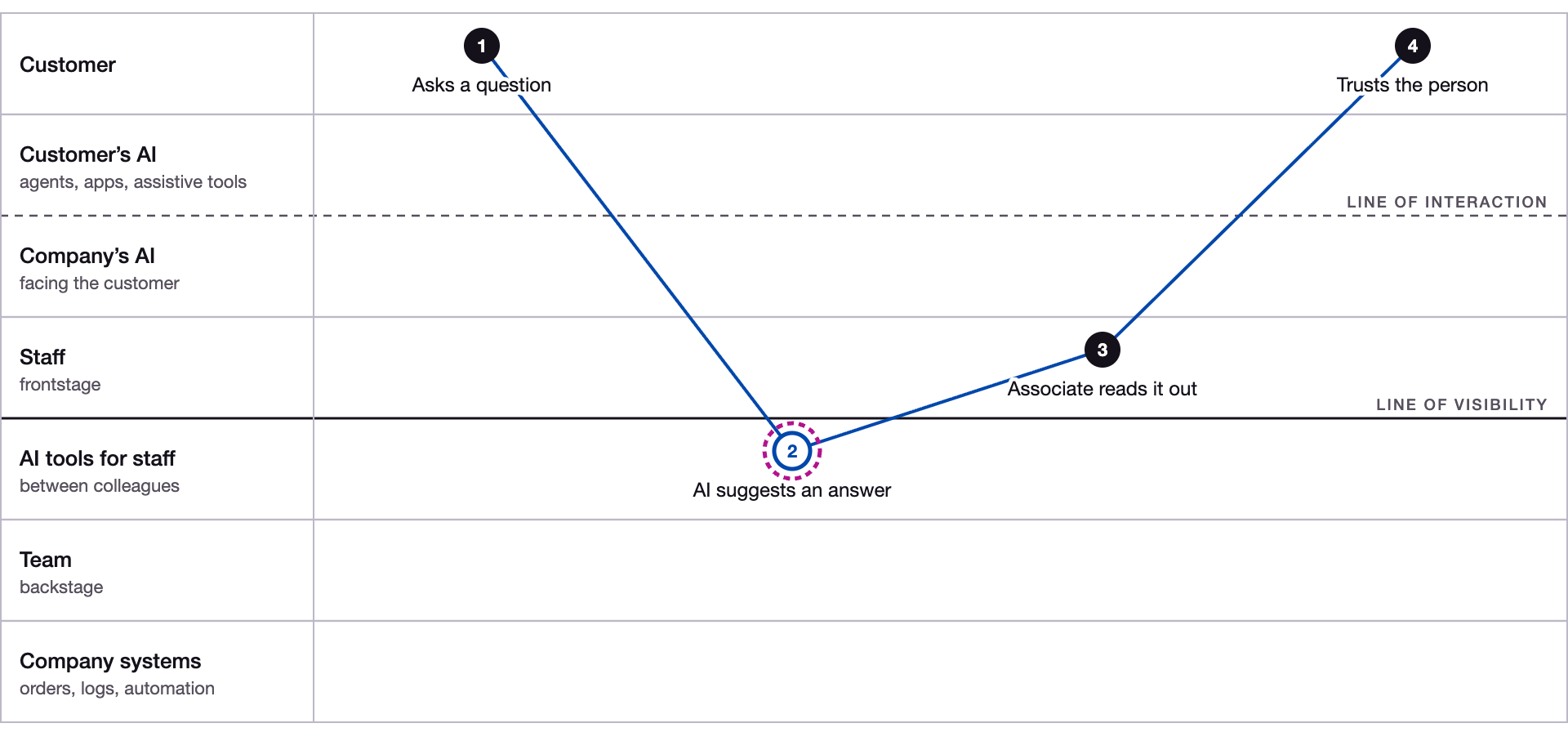
Steps as text
- Asks a question (Customer)
- AI suggests an answer (AI tools for staff)
- Associate reads it out (Staff)
- Trusts the person (Customer)
Hidden party: The AI that wrote the answer
Ask: Who answers for the words: the associate or the system?
The reply
Customer service with AI > Customer with AI
An AI answers a complaint written with AI. It can be closed without anyone reading it properly.
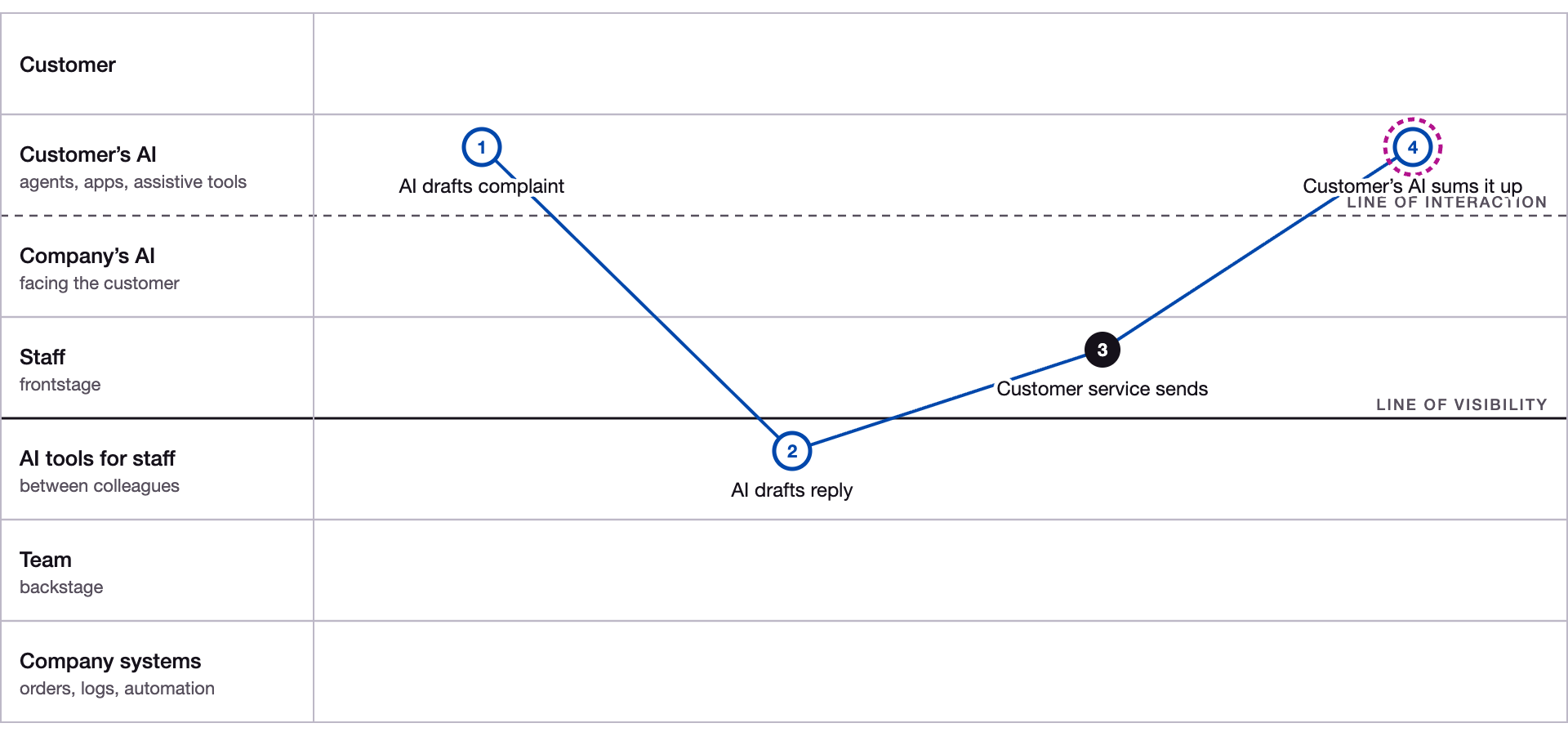
Steps as text
- AI drafts complaint (Customer’s AI)
- AI drafts reply (AI tools for staff)
- Customer service sends (Staff)
- Customer’s AI sums it up (Customer’s AI)
Hidden party: The customer’s AI, reading the reply
Ask: Did any person read the complaint properly?
The unapproved AI tool
Staff > Personal AI tool > Customer
Staff paste a complaint into their own AI tool to draft the reply. The customer’s details leave the company, and nobody knows.
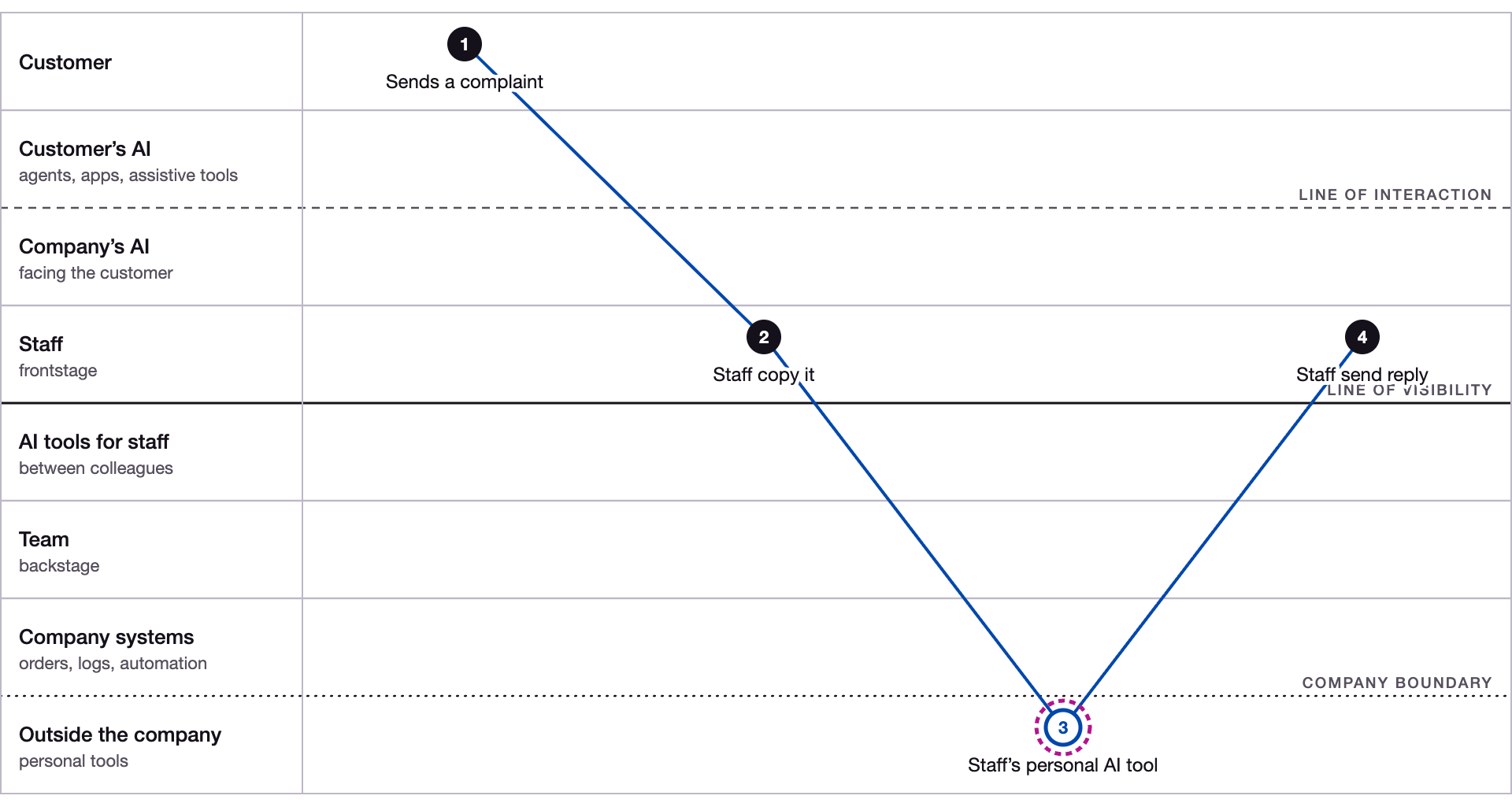
Steps as text
- Sends a complaint (Customer)
- Staff copy it (Staff)
- Staff’s personal AI tool (Outside the company)
- Staff send reply (Staff)
Hidden party: The company behind the personal AI tool
Ask: Where did the customer’s details just go?
The decision
Company’s AI > Customer, in writing
The refund is refused. The customer doesn’t know if a person looked, or how to ask one.
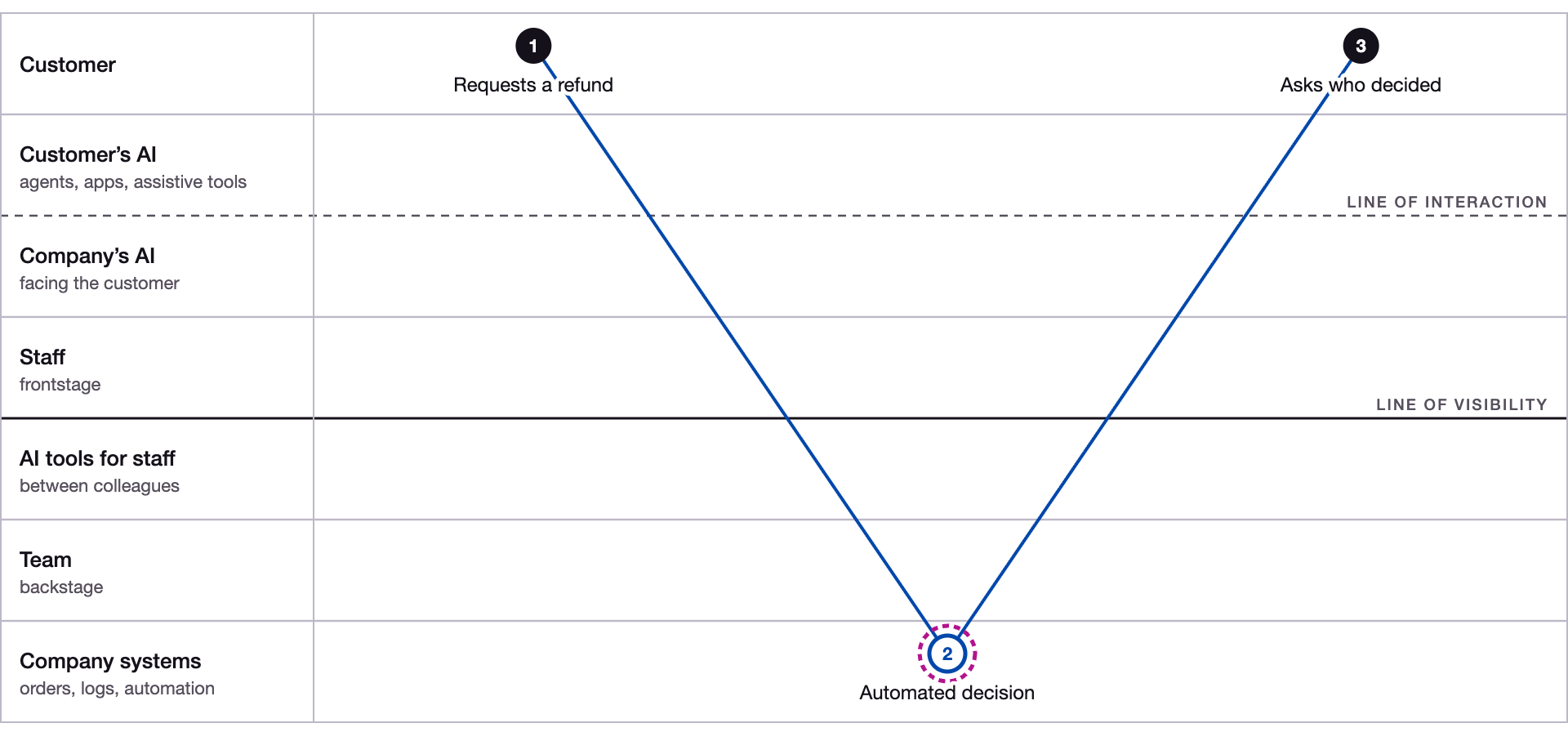
Steps as text
- Requests a refund (Customer)
- Automated decision (Company systems)
- Asks who decided (Customer)
Hidden party: The AI that made the decision
Ask: Can the customer find out who decided and reach a person?
The call
Company’s AI > Customer, by phone
It sounds like someone from the shop. In the EU, it must now say it’s an AI. The customer has seconds to decide what to share.
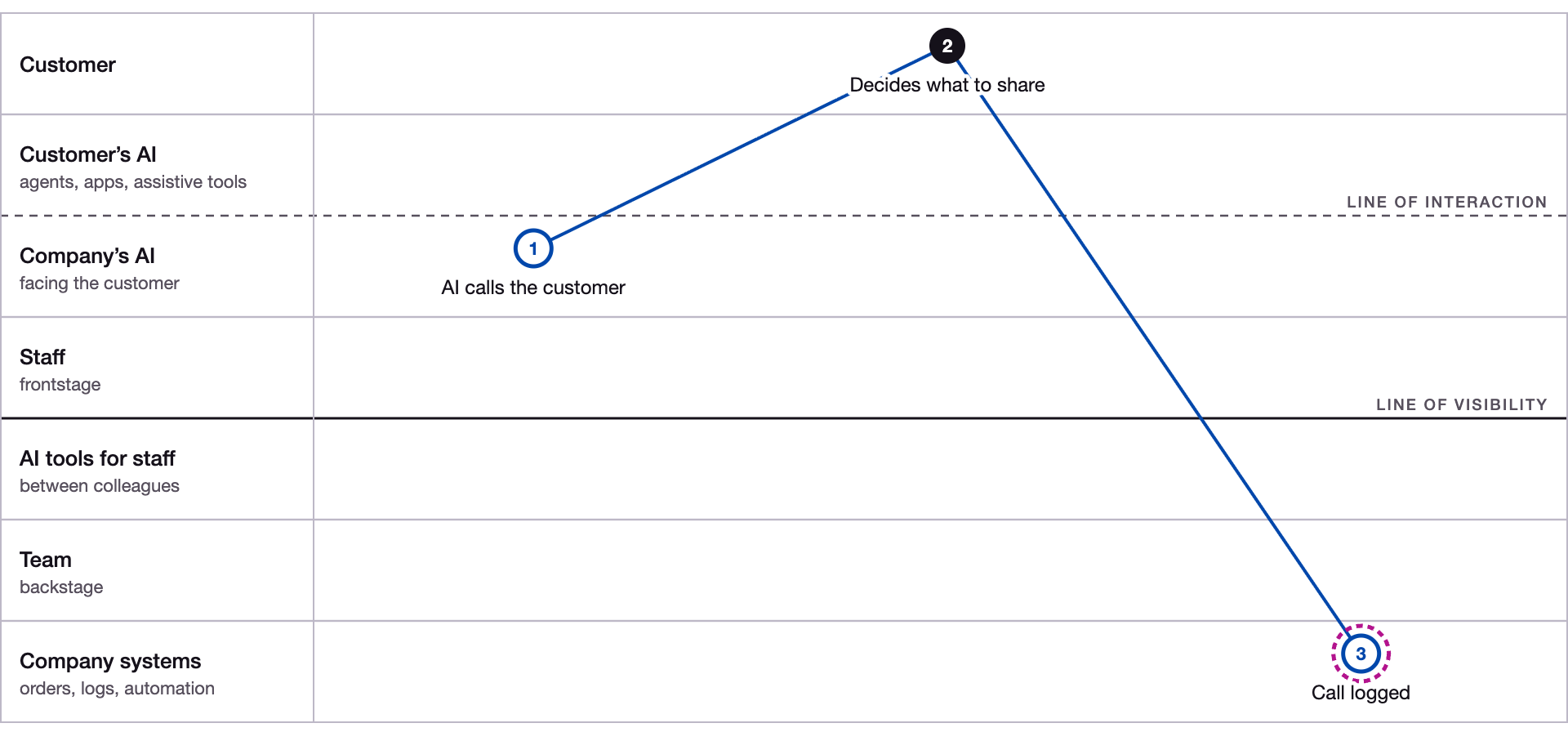
Steps as text
- AI calls the customer (Company’s AI)
- Decides what to share (Customer)
- Call logged (Company systems)
Hidden party: Whoever opens the call log later
Ask: Does the call say it is an AI, and what happens to the recording?
The customer who records
Staff > Customer’s phone or smart glasses
The customer records or transcribes the conversation. Staff don’t know who will see it, and nobody tells them.
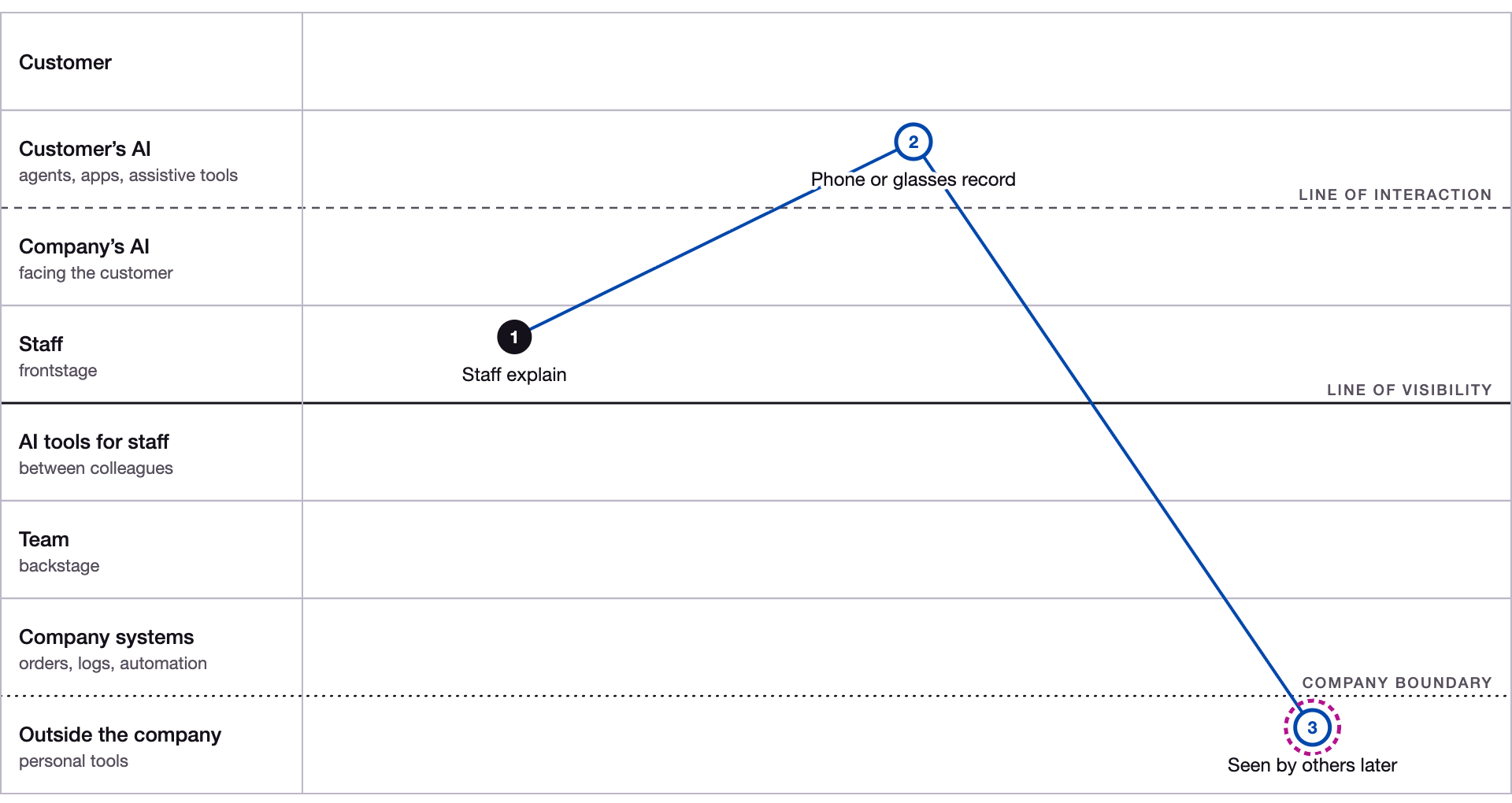
Steps as text
- Staff explain (Staff)
- Phone or glasses record (Customer’s AI)
- Seen by others later (Outside the company)
Hidden party: Whoever sees the recording later
Ask: What do staff know about who will see this?
The AI answering for the shop
Shop website > Public AI tool > Customer
Public AI tools read the site and answer questions about returns. If a page is hard to read, the answer is wrong, and customer service inherits it.
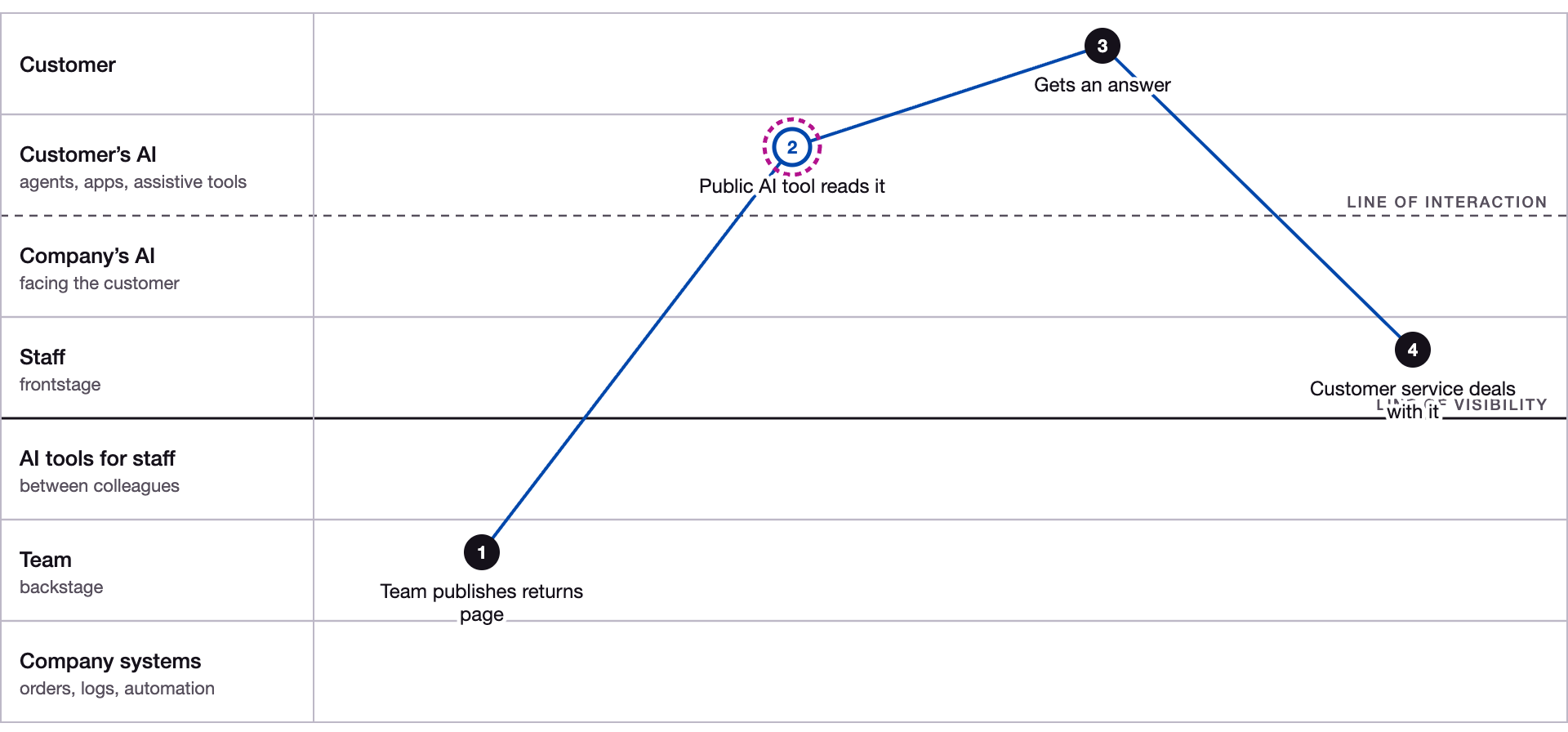
Steps as text
- Team publishes returns page (Team)
- Public AI tool reads it (Customer’s AI)
- Gets an answer (Customer)
- Customer service deals with it (Staff)
Hidden party: The public AI tool reading the site
Ask: Can an AI tool read your returns page correctly?
The guardrail exit
Customer > AI > Contact page > Email or phone
If the AI only covers products, a returns question becomes a link. The customer starts again with a new listener, and the chat doesn’t follow.
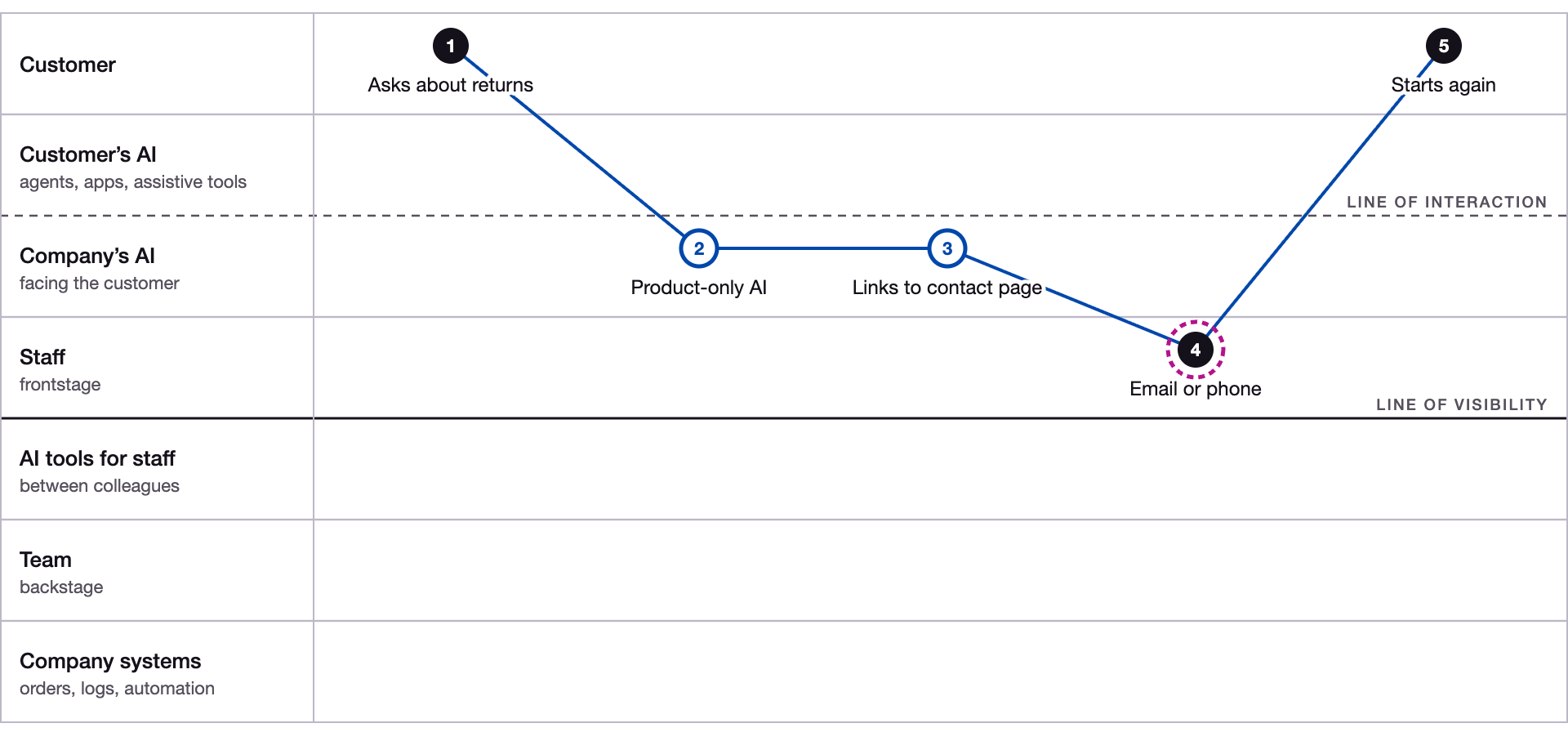
Steps as text
- Asks about returns (Customer)
- Product-only AI (Company’s AI)
- Links to contact page (Company’s AI)
- Email or phone (Staff)
- Starts again (Customer)
Hidden party: The colleague who never sees the chat
Ask: When the AI hands off, does the conversation follow?
Accessibility
AI can open the door for disabled customers, or close it.
The AI reading the shelf
Shelf label > Customer’s AI > Blind customer
An app reads labels aloud. If the camera can’t read a label, the customer can’t either.
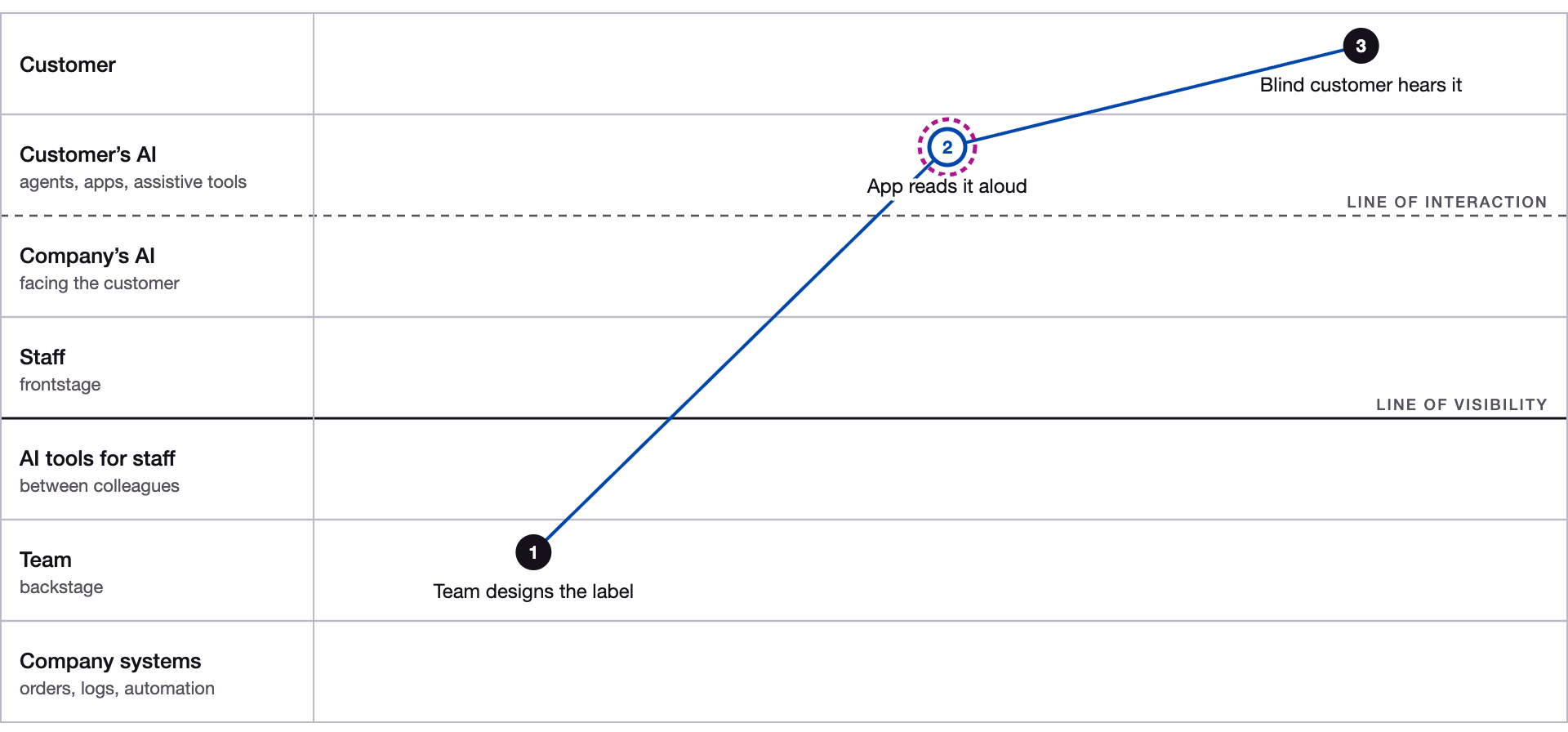
Steps as text
- Team designs the label (Team)
- App reads it aloud (Customer’s AI)
- Blind customer hears it (Customer)
Hidden party: The app reading the label
Ask: Has anyone tested the label with a reading app?
The chat a screen reader can’t hear
Company’s AI > Screen reader > Blind customer
If new messages aren’t announced, the answer arrives in silence. The “this is AI” notice has to be accessible too.
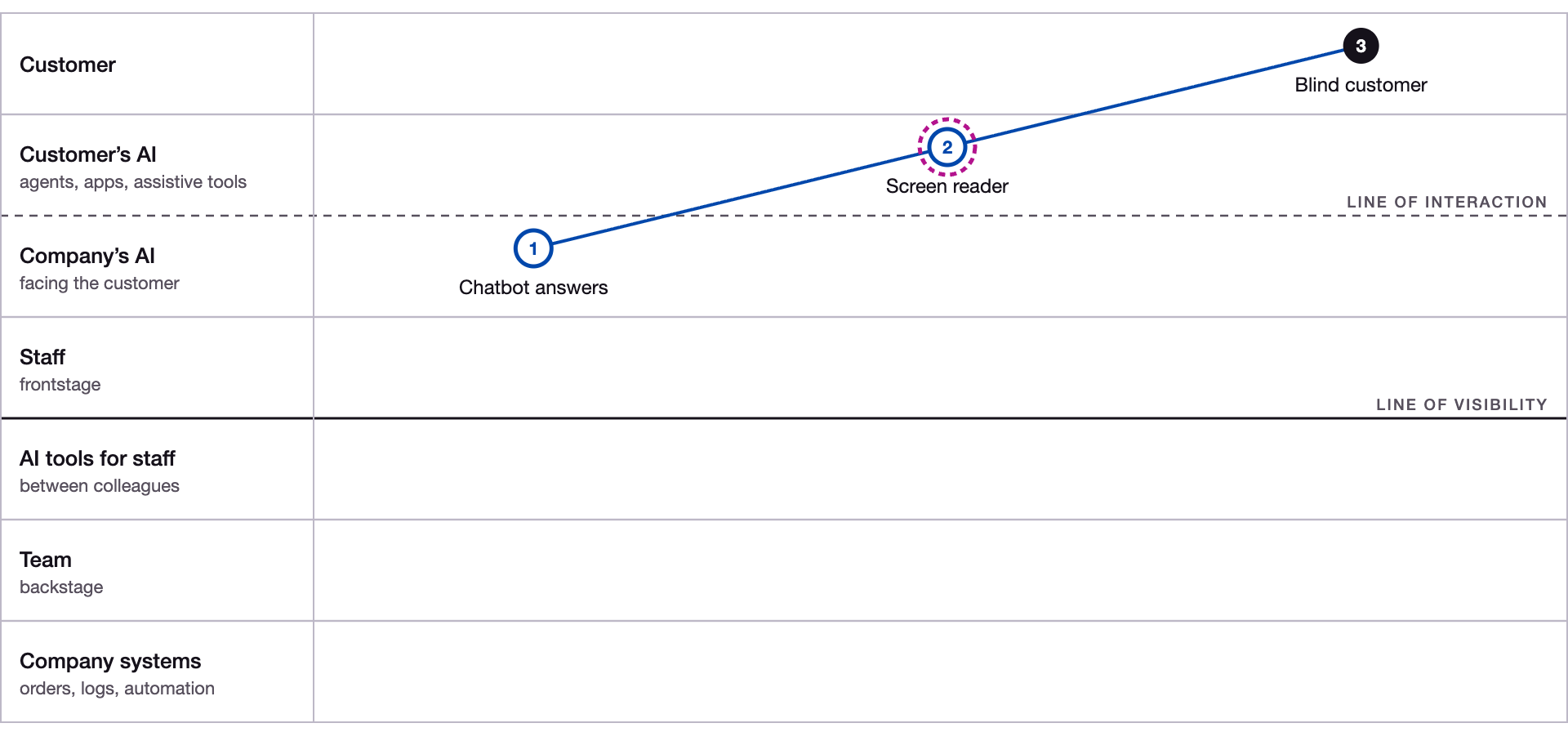
Steps as text
- Chatbot answers (Company’s AI)
- Screen reader (Customer’s AI)
- Blind customer (Customer)
Hidden party: The screen reader, which has to announce the reply
Ask: Are new messages and the AI notice announced?
The voice bot that doesn’t wait
Customer who stammers > Company’s voice AI
The bot cuts in or times out. The customer is misheard, and the transcript records something they didn’t say.
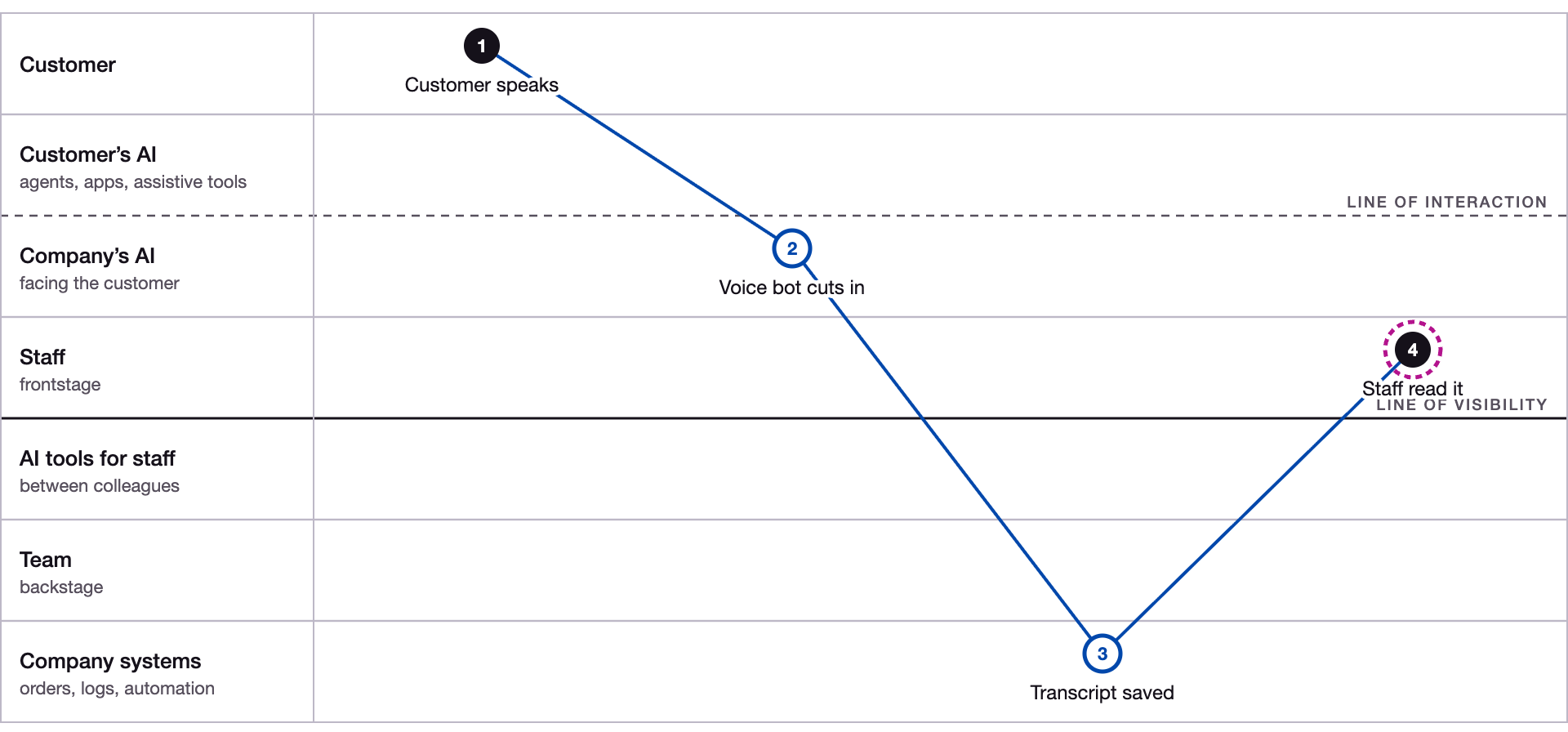
Steps as text
- Customer speaks (Customer)
- Voice bot cuts in (Company’s AI)
- Transcript saved (Company systems)
- Staff read it (Staff)
Hidden party: Staff reading a transcript that misheard
Ask: Was the voice bot tested with voices like this?
Who should answer
Not every question needs the same AI. Match the question to the method, and keep people for judgement.
| Question | Who or what answers |
|---|---|
| Order status | A direct lookup in the order system |
| Returns eligibility | The returns policy, applied as rules |
| Recurring complaints | AI reading across tickets and returns |
| Goodwill gestures | A person |
Table source: InsyteGroup, The retention opportunity sitting in your customer service desk, IMRG blog, October 2026.
Every limit on what an AI answers creates a new flow, as in the guardrail exit above. Draw that flow too.
Who owns the chain?
Every flow has an owner. The chain between them usually doesn’t.
- One map: every place a conversation is heard, recorded, summarised or handed over, and every page AI reads.
- One owner: someone accountable for the whole map, not just a single tool.
- One set of rules: how long records and their summaries are kept, who can open them, and a log of who did.
- One test: walk the journey as a customer, across every handoff, not one tool at a time.
What to design
- Tell customers and staff when AI is listening, what is kept and who reads it.
- Mark answers drafted by AI, and offer a person who can look again.
- Show customers what their AI agent is about to submit.
- Pass the full context at every handoff, and link summaries to their source.
- Write returns, delivery and product facts in plain, structured text that AI can read.
- Test transcripts and labels with the people most likely to be misheard or misread.
- Check who is speaking in more than one way, not only by phone.
Running the session
Use this as a 90-minute working session with the people who own each part of the chain.
- Pick three scenarios your service already has. Start from real tickets, calls or chats, not from this list.
- Draw each one on the lanes. Mark every person, every AI and every handoff.
- Circle the hidden party, and write down who it is by name or team.
- Ask the question under each scenario, and record who in the room could answer it.
- Read each blueprint with Blueprint Grammar. A thin handoff summary is usually Exchange; a decision nobody can see is usually Dependency.
Who does what
- Customer service lead: brings real cases and owns the handoffs between AI and staff.
- Store operations: knows where headsets, recordings and shift notes sit.
- Digital product: owns the chatbot, the returns pages and what AI tools can read.
- Data protection: answers what is kept, for how long, and who can open it.
- Accessibility: tests the flows with screen readers, captions and varied voices.
The instrument
This article comes with a blank blueprint template: the seven lanes, the outside lane, the line of interaction and the line of visibility, with space for the scenario, the hidden party and the question to ask. Print one sheet per scenario, or copy it into your whiteboard tool.